 Payal Agarwal
 April 16, 2026
 9 min read
 213
213Table of Contents
The healthcare industry is currently undergoing a significant transformation. For years, medical systems have struggled with a heavy burden: a rising number of patients, a shrinking workforce, and an overwhelming amount of paperwork. These challenges have made it difficult for clinicians to focus on their primary goal: caring for people.
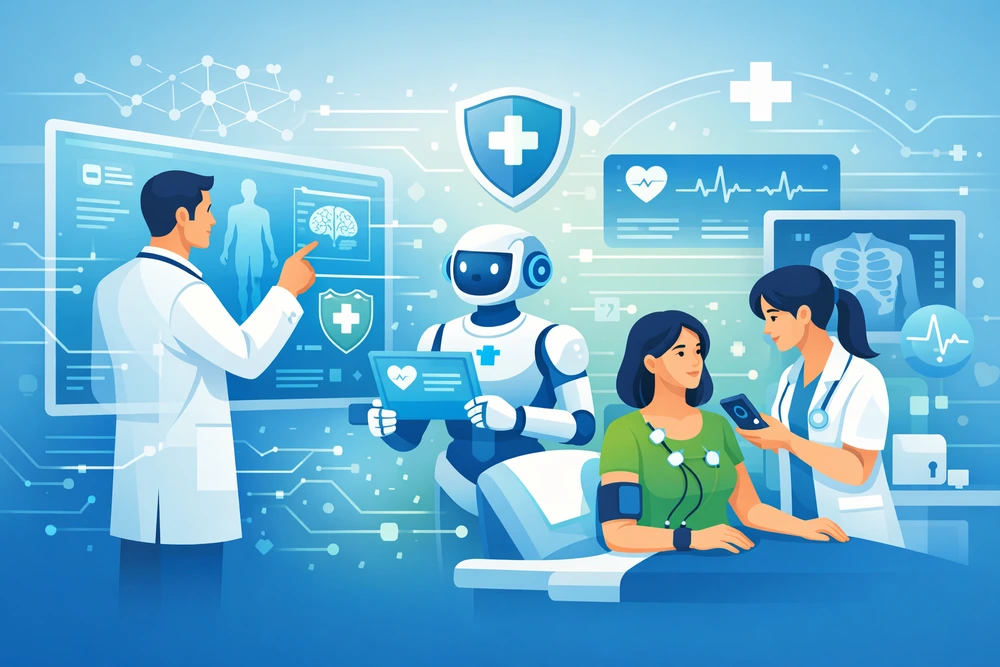
Today, artificial intelligence is stepping in as a vital support system. It acts as a digital foundation that helps hospitals and clinics operate with more precision. Whether it is identifying a stroke in seconds or predicting the most effective cancer treatment based on a patient’s DNA, AI is bridging the gap between an overstretched system and high-quality care.
Why AI is Exploding in Healthcare in 2026
The rapid adoption of these tools is not just a trend; it is a response to the urgent needs of the medical community. The global AI in the healthcare market is projected to reach USD 110.61 billion by 2030.
This shift is happening for three specific reasons:
- The Global Workforce Shortage: The World Health Organization continues to report severe gaps in the medical workforce. AI fills these gaps by handling routine tasks and complex data analysis.
- Administrative Efficiency: Administrative costs still consume up to 30% of hospital budgets. Automation is the only way for hospitals to remain financially healthy while lowering costs for patients.
- Data Overload: Modern medicine generates more data than any human can process. AI is the only tool capable of turning trillions of data points into a clear plan for a doctor.
In this blog, we explore the 10 most influential AI tools and platforms that are defining the healthcare landscape in 2026.
The Top 10 AI Tools and Platforms for Healthcare in 2026
1. Merative (formerly IBM Watson Health)
Focus: Clinical Decision Intelligence
Merative has evolved the original Watson AI into a specialized tool for high-stakes clinical decisions. In 2026, its standout feature is “MarketScan.” This platform analyzes millions of de-identified patient records to find real-world evidence for treatment success.
- Key Features: It uses “Contextual AI” to understand unstructured notes and laboratory data. It identifies the best clinical trials for specific patient profiles.
- Use Case: An oncology team uses Merative to build a treatment plan for a patient with a rare stage 4 cancer. The AI compares the patient’s data against the most successful global cases to recommend a specific immunotherapy drug.
- Website: merative.com
2. Aidoc
Focus: Emergency Radiology
Aidoc is an “always-on” AI that works in the background of radiology departments. It scans every image as soon as the technician takes it. If it finds a life-threatening issue, it moves that scan to the top of the doctor’s priority list.
- Key Features: It detects critical conditions like brain bleeds, pulmonary embolisms, and fractures. The system integrates directly into existing hospital software without requiring extra clicks.
- Use Case: A patient arrives at the ER with a severe headache. Before the radiologist even opens their file, Aidoc identifies an intracranial haemorrhage and alerts the surgical team immediately.
- Website: aidoc.com
3. PathAI
Focus: Pathology Imaging
PathAI uses machine learning to assist pathologists in identifying cancer at the cellular level. It acts as a second set of eyes that never gets tired and can see patterns that the human eye might miss.
- Key Features: It provides high-resolution digital mapping of tissue samples. It can quantify the density of cancerous cells to help determine the exact stage of a tumor.
- Use Case: A pathologist uses PathAI to review a breast biopsy. The AI highlights small clusters of malignant cells that were difficult to see. This leads to a more accurate diagnosis and a more effective surgery plan.
- Website: pathai.com
4. Google DeepMind Health
Focus: Diagnostic Early Warning
DeepMind is now a leader in preventative diagnostics. While it started with eye scans, it has expanded to predict organ failure and complex clinical outcomes hours before they occur.
- Key Features: It uses deep learning to detect over 50 different eye conditions with 94% accuracy from a single scan. It also has a predictive model for “Acute Kidney Injury” that warns doctors of risk 48 hours in advance.
- Use Case: During a routine check-up, a diabetic patient receives an eye scan. DeepMind identifies early signs of retinopathy that are not yet affecting the patient’s vision. This allows for early treatment to prevent blindness.
- Website: deepmind.google
5. Heidi AI
Focus: Ambient Documentation
Heidi AI is the most popular “ambient scribe” in 2026. It listens to the natural conversation between a doctor and a patient and writes the clinical notes automatically.
- Key Features: It supports over 12 languages and 300 medical specialties. It never stores raw audio, which ensures patient privacy while providing high-quality summaries.
- Use Case: A pediatrician in a busy rural clinic uses Heidi AI during back-to-back appointments. Instead of typing notes after work, the doctor reviews the AI-generated summaries at the end of each visit and saves two hours of work every day.
- Website: heidihealth.com
6. Tempus
Focus: Precision Medicine
Tempus uses data to make treatment personal. It combines a patient’s genetic sequence with their entire clinical history to help doctors understand how they will respond to certain drugs.
- Key Features: It houses one of the largest molecular and clinical data libraries in the world. It uses “Genomic Profiling” to find specific DNA mutations that drugs can target.
- Use Case: A doctor uses Tempus for a patient whose depression is not responding to standard pills. The AI identifies a genetic reason why the patient cannot process certain medications and suggests a targeted alternative that works within weeks.
- Website: tempus.com
7. Viz.ai
Focus: Care Coordination
Viz.ai is a communication and analysis platform designed for time-sensitive emergencies. It connects specialists across different hospitals so they can coordinate care in real time.
- Key Features: Recent 2026 data shows that Viz.ai reduced stroke transfer times by 44%. Its new “Viz Assist” tool automates the process of notifying specialized care teams.
- Use Case: When a patient has a stroke in a small community hospital, Viz.ai sends the brain scans to a large neurosurgery center instantly. The surgical team is already scrubbed in and ready the moment the patient arrives by ambulance.
- Website: viz.ai
8. eClinicalWorks AI EMR
Focus: Clinical Workflow
eClinicalWorks has turned the traditional electronic medical record into a conversational tool. By integrating with AI assistants like Sunoh.ai, it handles everything from documentation to scheduling.
- Key Features: It includes a “No-Show” prediction model that is 90% accurate. It also features “Image AI” which automatically sorts and files incoming medical faxes.
- Use Case: A clinic manager uses the EMR to see which patients are likely to miss their appointments. The system automatically reaches out to those patients to offer telehealth options, ensuring the clinic remains profitable and patients stay on track.
- Website: eclinicalworks.com
9. Olive AI
Focus: Administrative Automation
Olive AI focuses on the “hidden” side of healthcare. It automates the repetitive business tasks that often lead to hospital delays and billing errors.
- Key Features: It acts as a digital worker for the “Revenue Cycle.” It handles insurance claim submissions and checks hospital supply levels to prevent shortages.
- Use Case: A hospital uses Olive AI to manage its billing department. The AI identifies errors in insurance claims before they are sent, which reduces the number of denied claims and speeds up the hospital’s payment cycle.
- Website: oliveai.in
10. Butterfly Network
Focus: Portable AI Imaging
The Butterfly iQ3 is a handheld ultrasound device that connects to a smartphone. It makes high-quality imaging available anywhere from an ER to a remote village.
- Key Features: It uses “Ultrasound-on-Chip” technology. The AI provides on-screen guidance to help the user place the probe correctly, ensuring they get a diagnostic-grade image every time.
- Use Case: A nurse in a remote community uses the Butterfly probe to check a pregnant woman’s progress. The AI guides the nurse to the correct position to see the baby’s heart rate, providing reassurance without a long trip to a major city.
- Website: butterflynetwork.com
How AI is Improving Medical Diagnosis and Patient Care
AI is now a practical tool that replaces slow manual workflows with instant data analysis and precision, leading to direct and measurable results:
- Greater Diagnostic Accuracy: AI identifies subtle patterns in medical data that are easy to miss. Unlike humans, software does not get tired, ensuring consistent precision throughout a 12-hour shift.
- Faster Emergency Response: Automated triage tools scan imaging results instantly. This allows specialists to identify and treat critical conditions like strokes or hemorrhages much faster than manual review.
- Tailored Treatment Plans: AI analyzes a patient’s genetic code and medical history to suggest specific medications. This replaces the “one size fits all” approach and reduces the risk of negative drug reactions.
- Reduced Administrative Burden: By automating clinical notes and billing, AI removes hours of paperwork from a doctor’s schedule. This shift allows clinicians to spend more face-to-face time with their patients.
- Better Access to Care: Portable, AI-guided devices allow non-experts to perform complex diagnostic scans in rural or remote areas, bringing high-quality care to more people.
Conclusion
The tools we have seen show that the medical world is moving toward a more efficient system. We are leaving behind a setup defined by long wait times and overworked staff. Instead, technology is now handling the heavy lifting and repetitive manual tasks.
These platforms are changing the daily routine in clinics and hospitals by saving hours of time and catching errors before they happen. By cutting through the noise, these tools help the entire system run more reliably for everyone involved.
To learn more about the latest in medical AI and other topics related to health and wellbeing, explore our extensive collection of articles.
1. Which AI is best for healthcare?
There isn’t a single “best” AI because different tools solve different problems. If a clinic is struggling with paperwork, an ambient tool like Heidi AI is often considered the best for saving time. However, for a radiology department, a tool like Aidoc is the gold standard for identifying life-threatening issues in scans. The best tool is simply the one that solves a provider’s most urgent bottleneck.
2. Which are the top 5 AI tools?
Based on current clinical impact and adoption rates, the top five tools are:
Heidi AI: For automating clinical documentation and notes.
Aidoc: For real-time triage in emergency radiology.
Google DeepMind Health: For early disease detection and diagnostic research.
PathAI: For high-precision pathology and cancer staging.
Tempus: For data-driven personalized medicine and genomic profiling.
3. What is AI used for in the healthcare industry?
AI is primarily used to handle tasks that require processing massive amounts of data very quickly. This includes:
Diagnostics: Analyzing X-rays and MRIs to find abnormalities.
Administration: Automating billing, scheduling, and clinical note-taking.
Precision Medicine: Matching specific drugs to a patient’s genetic profile.
Triage: Identifying high-risk patients in an ER so they get treated first.
4. Do AI tools aim to replace healthcare professionals?
No. AI tools are designed to act as assistants, not replacements. The goal is to remove the “grunt work”, like hours of data entry and filing, so that doctors and nurses can spend more time with their patients. While AI can process data, it lacks the human judgment, empathy, and complex reasoning required to manage a patient’s overall care.
5. How do AI tools contribute to improving patient outcomes?
AI improves outcomes by increasing speed and accuracy. For example, it can catch a tiny tumour on a scan that a tired human eye might miss. It also speeds up the time it takes to get a diagnosis, which means treatment can start sooner. Additionally, by personalizing medicine to a patient’s specific DNA, AI helps reduce the risk of trial-and-error prescribing and negative drug reactions.
6. What types of data do AI healthcare tools typically analyze?
AI tools analyze a wide range of complex data, including:
a) Medical Imaging: CT scans, MRIs, X-rays, and ultrasound videos.
b) Electronic Health Records (EHR): Past medical history, lab results, and medication lists.
c) Genomic Data: Information from a patient’s DNA and molecular profile.
d) Ambient Audio: Conversations between doctors and patients to generate clinical summaries.
e) Real-time Vitals: Heart rate, blood pressure, and oxygen levels from hospital monitors or wearables.

Senior Executive – Content
Payal specializes in the healthcare, wellness, and insurtech space, with a strong focus on educating businesses about insurance and employee wellbeing. She is passionate about simplifying an industry that is often misunderstood and filled with complex jargon, translating it into clear and practical insights that organizations can easily understand and act on. Through her work, she aims to make the insurance ecosystem more transparent and accessible, helping businesses recognize that prioritizing employee wellbeing is not just a benefit but a responsibility.