Quick Summary
A relieving letter is an official document an employer gives to an employee who has resigned. It confirms that the person has finished their notice period, handed over their responsibilities, and is now formally released from their duties at the company.
What is a Relieving Letter?
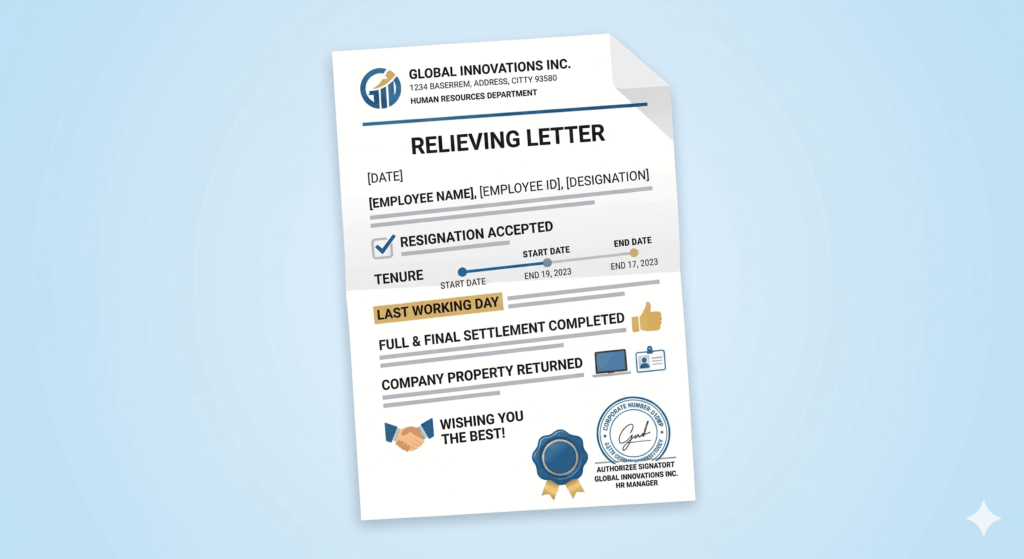
A relieving letter acts as the formal conclusion to an employee’s time at a company. Printed on official company letterhead, this document serves as a “no dues” certificate. It proves that the employer has accepted the person’s resignation and that the individual is now free to start a job at another organization.
In the Indian corporate world, this letter is typically issued on the employee’s last working day or once the Full and Final (FnF) settlement is finished. It marks the official end of the professional relationship and ensures that neither side has any remaining financial or administrative obligations.
Why Relieving Letters are Vital for Changing Jobs
This document is very important for both the company and the person leaving. HR managers should make sure it is issued on time for several reasons:
- Proof of Resignation: It provides written evidence that the employee left voluntarily and that the company approved the separation.
- Background Verification: Most professional companies in India conduct a background check. A relieving letter is the main document used to confirm that a candidate’s previous exit was clean and followed the contract.
- Notice Period Confirmation: It proves that the employee stayed for the required notice period, which shows they are professional and reliable.
- Closing the Files: For the company, issuing the letter confirms that all equipment (like laptops or access cards) has been returned and that all work has been handed over.
- Help with Financial Tasks: New employers often ask for this letter to help transfer Provident Fund (PF) accounts or to check previous salary details for tax purposes.
Essential Details in a Relieving Letter
A professional relieving letter should be short and clear. To be valid for future employers, it must include these specific points:
- Company Info: The official letterhead, logo, address, and the date the letter was written.
- Employee Details: The person’s full name, employee ID, their last job title, and their department.
- Resignation Context: A mention of the date the resignation was sent and when it was accepted.
- Dates of Employment: The exact start date and the official last working day.
- Clearance Statement: A sentence confirming that the employee has finished all exit steps and owes no money or assets to the company.
- Official Signature: The signature and seal of the HR head or an authorized manager.
The Step-by-Step Process for Issuing a Relieving Letter
Handling an exit requires a clear plan to make sure nothing is missed:
- Accept the Resignation: Once an employee gives notice, HR or the manager must reply formally to accept it and confirm the final working day.
- Clearance Tracking: The employee needs to visit different departments, like IT and Finance, to return equipment and settle any pending bills or loans.
- Knowledge Transfer: The manager should confirm that the employee has handed over their current projects and tasks to the person taking over.
- Final Settlement: The payroll team calculates the final payment, including any remaining salary or leave encashment.
- Issuing the Letter: The relieving letter is usually handed over on the last day after all clearances are signed. Many companies now send a digital copy via email as well.
Relieving Letter vs Experience Letter
While these two documents are often handed over at the same time, they serve different purposes.
| Feature | Relieving Letter | Experience Letter |
| Main Purpose | Confirms the formal exit and release from duties. | Confirms work history, roles, and how well the person performed. |
| Focus | Focuses on administrative clearance and “no dues.” | Focuses on skills, contributions, and achievements. |
| Timing | Issued only at the time of leaving. | Can be issued during or after employment. |
| Tone | Formal and administrative. | Descriptive and professional. |
When Can an Employer Withhold a Relieving Letter?
While it is standard to provide this letter, there are specific times when a company might delay or refuse to give it:
- Absconding: If an employee stops showing up for work without telling anyone, they have not followed the proper exit process.
- Unreturned Property: If company assets, like laptops, phones, or data, have not been returned.
- Unpaid Dues: If the employee still owes the company money for loans or has not paid for their notice period.
- Disciplinary Issues: If a person is fired for serious misconduct or theft, the company may give a termination notice instead of a relieving letter.
FAQs
1. Is a relieving letter mandatory in India?
There is no specific law that says a company must issue one, but it is considered a standard best practice. Most new employers will ask for it during the hiring process.
2. Can I join a new company without a relieving letter?
It is difficult. Most reputable companies need it to make sure you are not legally tied to another job. In a dispute, you might be able to use your resignation email and the acceptance reply as temporary proof.
3. How soon should a relieving letter be issued?
Ideally, it should be given on the last working day. However, some companies take 7 to 15 days to finish the final settlement and paperwork.
4. Does it include my behavior or conduct?
Usually, no. It is a factual document. Comments on your performance or behavior are normally kept for the Experience Letter.
5. Is a digital relieving letter valid?
In today’s workplace, a digitally signed PDF on company letterhead is legally valid and accepted by HR departments across the country.