 Diksha Gupta
 April 27, 2026
 8 min read
 96
96Table of Contents
India saw more than 2.04 million cybersecurity incidents in 2025. That’s about one every 15 seconds. The average cost of a cyber incident for an Indian business now exceeds ₹19 crore. And under the DPDP Act 2023, a single personal data breach can attract fines of up to ₹250 crore. For Indian SMEs, cyber risk is no longer a technology problem. It is a business survival problem.
Most business owners know they need to ‘do something’ about cyber risk. The confusion starts when deciding what. Cyber insurance and cybersecurity serve different purposes. Choosing one over the other is a common and costly mistake for Indian SMEs. This guide breaks down the key differences, what each covers, and why your business needs both in 2026.
What Is Cybersecurity?
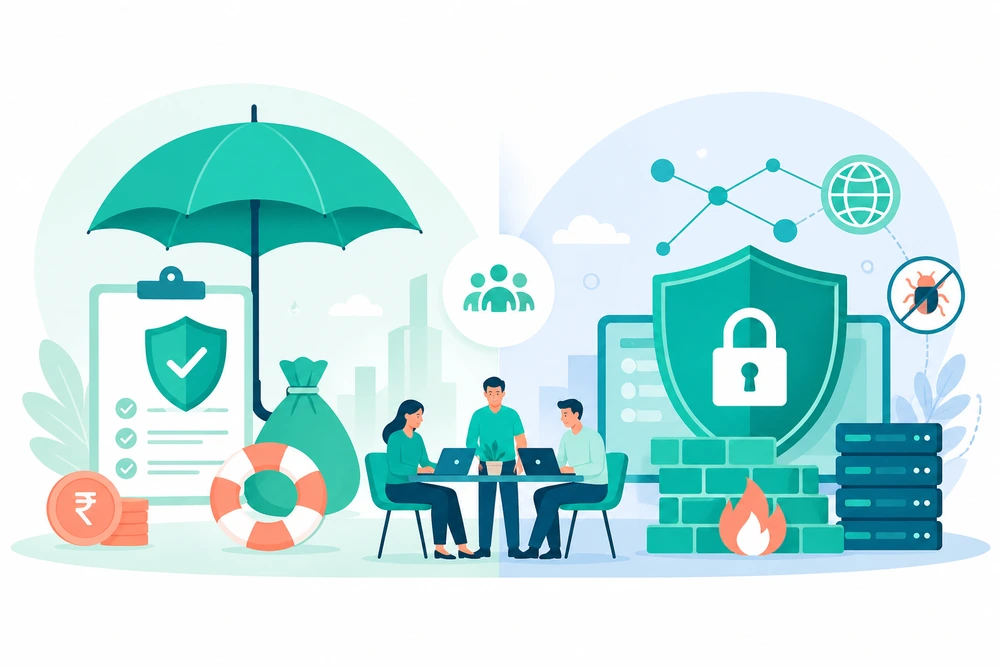
Cybersecurity includes tools, processes, and trained people. It helps prevent, detect, and respond to cyberattacks. This way, it stops major damage before it happens. Think of it as the lock, alarm system, and security guard protecting your business.
It works across three layers:
- Prevention: Firewalls block threats. Antivirus software catches viruses. Multi-factor authentication (MFA) adds security. Access controls limit who can see what. Employee phishing training helps staff spot scams. Together, they stop most attacks before they start.
- Detection: Monitoring systems spot unusual activity in real time. They flag suspicious logins or unexpected data transfers before things escalate.
- Response: Incident response plans and trained teams help contain and recover from attacks. They aim to minimize damage when prevention fails.
# Regulation: CERT-In guidelines from the IT Act 2000 outline basic cybersecurity duties for Indian businesses. Non-compliance, including failure to report incidents within 6 hours, can result in penalties. Cybersecurity is the lock on your door. It stops most threats. But no lock is unbreakable.
Common Types of Cyber Threats
- Phishing: Sending fraudulent emails that resemble emails from reputable sources to steal sensitive data like credit card numbers.
- Ransomware: A type of malicious software designed to lock you out of your files until a sum of money is paid.
- Malware: Software specifically designed to gain unauthorized access or cause damage to a computer (e.g., viruses, worms, and spyware).
- Social Engineering: A tactic that basically “hacks” the human element by tricking people into revealing confidential information.
Suggested read: Top 10 Cyber Security Threats: How Cyber Insurance Protects You
What Is Cyber Insurance?
Cyber insurance helps cover costs after a cyberattack. It’s a way to manage financial risks. It does not stop attacks; it covers the cost of surviving one. It operates across two coverage types:
First-party cover
This covers the direct costs your business incurs to handle the immediate crisis, such as:
- Data Recovery: Costs to restore or recreate lost or damaged digital data.
- Ransomware Payments: Coverage for ransom demands (though this is becoming more restricted by insurers).
- Business Interruption: Reimbursing lost income if your systems are down and you cannot operate.
- Forensics: Hiring experts to find out how the hack happened and how to stop it.
- Notification Costs: The legal requirement to notify customers if their personal data was stolen.
Third-party cover
This covers your legal responsibility to others if an attack on your systems harms them:
- Legal Fees: Costs to defend yourself in court or pay settlements.
- Regulatory Fines: Helping pay penalties from government agencies for failing to protect data.
- Privacy Liability: Protection if a customer sues you because their private information was leaked.
IRDAI established India’s cyber insurance framework in 2017. The DPDP Act 2023 has greatly increased demand. Now, a breach by an untrained employee can lead to fines of ₹250 crore. India SME premiums range from ₹12,000 to ₹90,000/year for standard business cyber cover. Comprehensive ₹1 crore cover starts at approximately ₹2 lakhs annually.
Quick read: 6 Types of Business Insurance Policies to Consider for Risk and Legal Protection
Key Differences: Cyber Insurance vs Cybersecurity
Here is how cyber insurance and cybersecurity differ across every dimension that matters to a business owner:
| Factor | Cybersecurity | Cyber Insurance |
| Purpose | Prevent cyberattacks from succeeding | Cover financial losses after an attack occurs |
| When it acts | Before and during an incident | After an incident has occurred |
| What it involves | Tools, processes, and trained people | A financial policy with defined payouts |
| What it covers | Firewalls, encryption, MFA, employee training | Legal costs, ransom, data recovery, fines, PR |
| India regulation | CERT-In guidelines, IT Act 2000 | IRDAI cyber insurance framework, DPDP Act 2023 |
| SME cost range | ₹50,000–₹5L+/year (tools + training) | ₹12,000–₹90,000/year (premium) |
| Replaces the other? | No — both are needed for complete protection | No, both are needed for complete protection |
The table above shows two tools solving two different problems. Choosing one instead of the other is like having a lock but no fire insurance, or fire insurance but no lock. Both serve a purpose. Neither replaces the other.
Why do Indian SMEs need both?
Cybersecurity reduces the probability of an attack winning. Cyber insurance reduces the financial damage when one does succeed. No cybersecurity is 100% effective, even companies with enterprise-grade security get attacked. And no cyber insurance policy pays out if you have zero security controls in place.
In India, digital fraud is at an all-time high. For an SME, “being careful” isn’t enough anymore. You need a two-part defense system.
One is your technical tool and the other is your financial tool.
1. Cybersecurity
What it is: The locks on your doors and the cameras in your office.
- The Job: It stops hackers from entering your system, stealing your customer list, or sending fake SMS in your name.
- Why in India? The government (TRAI) mandates a system called DLT. If you don’t have this “shield” set up, you aren’t allowed to send business SMS at all.
- The Goal: Prevention.
2. Cyber Insurance
What it is: The backup plan if the “Shield” fails.
- The Job: If a hacker does get through and steals money or data, insurance pays for the lawyers, the technical repairs, and the government fines.
- Why in India? India’s new data laws (DPDP Act) can fine a business crores of rupees for a single data leak. Most SMEs would go bankrupt paying that; insurance pays it for you.
- The Goal: Recovery.
Recommended read: A Step-by-Step Guide for Buying Business Insurance in India
What Cyber Insurance Covers? And Not Covered?
| Typically Covered | Typically Not Covered |
| Data breach response costs | Pre-existing vulnerabilities known before policy |
| Ransomware payment & recovery | Intentional acts or insider fraud |
| Legal defence & regulatory fines | Nation-state cyberattacks (often excluded) |
| Business interruption losses | Indirect reputational damage |
| PR & crisis communication costs | Bodily injury or physical property damage |
| Third-party notification expenses | Prior breaches not disclosed at inception |
Important: Coverage terms vary significantly across Indian insurers. Always read the policy exclusions section before signing. What is excluded matters as much as what is covered
How to Decide What to Prioritise First
Step 1: Priority One is Cybersecurity
You cannot skip cybersecurity to buy insurance. In fact, most insurance companies in India will refuse to cover you if you don’t have basic security in place.
- Why it’s first: It’s like trying to get car insurance while telling the agent you don’t have brakes or a lock on the door. They won’t take the risk.
- The “Must-haves”: To even apply for insurance, an SME needs:
- MFA (Multi-factor Authentication): Mandatory for all logins.
- DLT Registration: Required by TRAI to send any business SMS.
- Basic Backups: To prove you can recover if hit by ransomware.
Step 2: Priority Two is Cyber Insurance
Once your basic “locks” are on the door, you get insurance to protect you from what you can’t control.
- Why it’s urgent: Under India’s DPDP Act, a single data leak can lead to fines up to ₹250 Crore. No SME can pay that out of pocket.
- Insurance is there for when a human error happens (like an employee clicking a bad link), which no software can 100% prevent.
How to Decide: The 3-Question Test
Answer these three questions to set your budget and then the decision is in front of you:
- Do I handle customer phone numbers or Aadhaar?
- If Yes: Cybersecurity is your legal priority today to avoid immediate TRAI/Govt blocking.
- Could my business survive a ₹50 Lakh legal fee?
- If No: Cyber Insurance is your financial priority to ensure you don’t go bankrupt after a hack.
- Does my insurer require specific tech?
- Check first: Many Indian insurers now offer “Bundled” deals where they give you a discount if you use their approved cybersecurity tools.
Also read: How Essential is Business Insurance for Tech Startups?
Why Onsurity Cyber Insurance is the Right Choice for SMEs
For an Indian SME, Onsurity’s cyber insurance policy is often the right choice because it is built specifically for the constraints of small businesses,namely budget, speed, and lack of in-house legal experts.
Here is why:
1. It’s “SME-priced”
Traditional cyber insurance can be incredibly expensive and often requires a massive upfront annual premium.
#Onsurity offers covers like ₹1 Crore starting at approximately ₹50,000 per year. This allows an SME to get “big corporation” protection at a price that fits a startup or small office budget.
2. Tailored for Indian Laws (DPDP Compliance)
India’s Digital Personal Data Protection (DPDP) Act can fine businesses up to ₹250 Crore for data leaks.
#The policy is designed with these specific Indian regulations in mind. It covers the regulatory fines and investigation costs that an Indian business would face if they accidentally leaked customer phone numbers or Aadhaar data.
3. Professional Risk Mitigation & Assessment
Before you even sign a policy, Onsurity performs a deep gap analysis to identify hidden vulnerabilities. We look for technical cyber risks and physical liabilities that are often overlooked, such as hazardous storage or specific industry dangers.
4. Specialized Policy Underwriting
We don’t believe in generic, expensive templates. Our experts use high-level, tech-driven underwriting to price your risk based on real industry data. Whether you are in Fintech, Pharma, or Wellness, your coverage is “right-sized.”
5. Expert Policy Placement
We leverage our strong relationships with leading Indian insurers to find the perfect match for your business. We prioritize partners who offer:
- Superior Clauses: Better terms and conditions for your protection.
- Proven Reliability: Over 95% claim settlement ratios.
- End-to-End Support: Our dedicated teams handle the bureaucracy and paperwork, providing a seamless experience from start to finish.
Final Word
Cybersecurity is your first line of defence. Cyber insurance is your financial recovery plan. Together, they form a complete cyber risk strategy for any Indian business in 2026. Both are necessary. The DPDP Act, rising ransomware, and human error mean every company needs these layers, no matter the size.
The question is not which one to choose; the question is where to start.
There’s no one-size-fits-all solution for cyber protection. Get a personalised cyber security assessment with Onsurity.
FAQs
1. Is cyber insurance the same as cybersecurity?
No. Cybersecurity prevents attacks using tools, processes, and trained people. Cyber insurance covers the financial losses when an attack succeeds. They solve different problems and work best together, one reduces the probability of a breach, the other reduces the cost of one.
2. Do small businesses in India need cyber insurance?
Yes, especially post-DPDP Act 2023. Any Indian business handling personal employee or customer data faces regulatory fine exposure up to ₹250 crore per breach. Basic SME cyber insurance policies start at ₹12,000/year, a fraction of the fine risk they cover.
3. What does cyber insurance typically not cover?
Most Indian cyber insurance policies exclude: pre-existing vulnerabilities known before the policy was issued, intentional acts or insider fraud, nation-state cyberattacks, indirect reputational damage, and breaches not disclosed at policy inception. Always read the exclusions section before buying.
4. Can I get cyber insurance without cybersecurity measures?
Increasingly, no. In 2026, most Indian cyber insurers require minimum security controls, MFA, endpoint protection, employee training, as a condition of coverage. Cybersecurity is now a prerequisite for insurance, not an optional extra.
5. How much does cyber insurance cost for SMEs in India?
Premiums range from ₹12,000 to ₹90,000/year for SMEs, depending on business size, the type of data handled, and existing security posture. Comprehensive ₹1 crore cover starts at approximately ₹2 lakhs annually. Better cybersecurity controls typically result in lower premiums.
6. How can I buy cyber insurance for my company?
You can visit our website to book a demo or connect with our customer support team for more details.

Clinical Content Strategist B.Pharma
A Senior Medical and Insurance Content Strategist with over 6 years of experience in healthcare, Ayurveda, and insurance, Diksha has written for industry leaders such as Onsurity, Tata 1mg, mfine, and Medi Assist. A Bachelor of Pharmacy graduate and the creator of the Insurance Dictionary; she holds a Professional Diploma in Counseling Psychology and is certified in Counseling and Guidance by the International Psychological Association.