 Diksha Gupta
 May 5, 2026
 8 min read
 142
142Table of Contents
In FY 2024–25 alone,₹30,000 crore worth of health insurance claims were rejected. Most of these rejections could have been avoided. Here is a number every HR manager should know: according to GIC, 47% of health insurance claims in India are still settled by reimbursement, not cashless. That means almost half of employees pay upfront and rely on a process many do not fully understand.
So what goes wrong, and how can you prevent it for your team? This guide explains the reimbursement claim process for group health insurance in India, step by step. It covers the IRDAI rules insurers must follow, the documents you need, and how HR teams can make the process much easier.
Cashless vs Reimbursement: What’s the Difference?
Both options allow you to use your group health insurance, but the experience differs significantly.
| Feature | Cashless Claim | Reimbursement Claim |
| How it Works | The insurer pays the hospital directly. | You pay upfront; claim back later. |
| Hospital Choice | Network Hospitals only. | Any hospital (Network + Non-network). |
| Your Payment | Only non-medical/consumables. | 100% of the hospital bill. |
| Paperwork | Minimal; handled by the hospital. | Extensive; you must collect all originals. |
| Notification | Within 24 hours of admission. | Within 24–48 hours of admission. |
| Speed | Instant (few hours). | Slower (15–30 days). |
| Best For | Emergency liquidity & convenience. | Preferred doctors outside the network. |
When Does Reimbursement Apply?
1. Non-network Hospitals
If you choose a hospital (or are rushed to one in an emergency) that is not in your insurer’s network, cashless is unavailable. You must pay upfront and claim later.
2. Before and After Hospitalization
For your problem/surgery, the cashless facility may apply, but only the money you spend before and after the surgery will be reimbursed. Such as tests, consultations, and meds before admission. Follow-ups, physio, and recovery meds after discharge.
3. Cashless Denial
A denied cashless request isn’t a claim rejection; it usually means the insurer needs more data. This often happens with:
- Pre-existing diseases require deeper investigation.
- Insufficient data provided by the hospital.
- Short-stay procedures that typically don’t require overnight admission.
4. Domiciliary Hospitalization
If you are treated at home due to a severe condition or because of a lack of hospital beds, insurers typically process these claims only through reimbursement.
Note: While most retail plans only allow domiciliary claims via reimbursement, many modern group policies now offer cashless facilities for home-based hospital care.
Also read: How Does the Health Insurance Claim Process Work
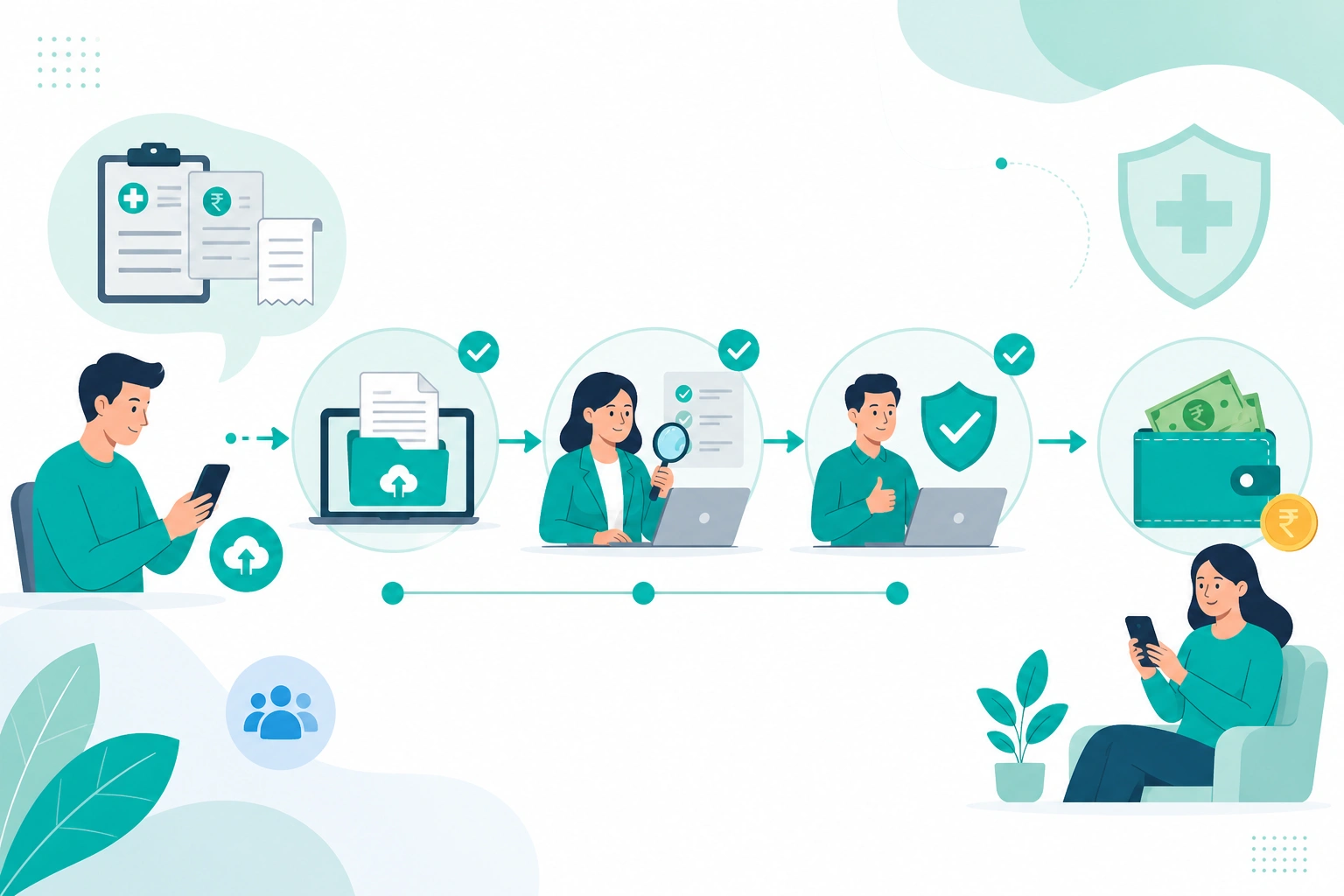
7 Steps to a Smooth Reimbursement
1. Inform Early: Inform your insurer within 24 hours (emergency) or 48 hours (planned), or as per the company’s rules. Informing late can be the reason for rejection
2. Collect Original Documents: Before discharge, obtain a discharge summary, all original bills, lab reports, and prescriptions.
3. File the claim form: Fill it out properly; digital filing is recommended to avoid manual errors.
4. Submit with either HR or TPA: Confirm if you want to submit via HR or directly to the TPA. Don’t be confused.
5. Fast Response: As per new rules, TPAs have one window after Day 10 to request missing data. Reply immediately to prevent claim closure.
6. 15-day Settlement: Under new guidelines, insurers must settle claims within 15 days of receiving all documents.
7. NEFT Credit: Funds are transferred directly. Double-check your bank details; a single wrong digit can cause weeks of delay.
Pro Tip: Keep a digital scan of every document and the submitted form for your records.
| #Important update for Step 6: As of IRDAI’s Master Circular on Protection of Policyholders’ 2024, states that settlement of claims (other than cashless) shall be settled within fifteen days from submission of claim. |
Your Documents Checklist
The Core Originals
- Claim Form: Fully filled and signed.
- Hospital Bills: Itemized originals and payment receipts.
- Discharge Summary: Must be typed and doctor-signed.
- Medical Trail: All lab reports, diagnostic scans, and pharmacy bills.
- Prescriptions: Every medication bill must have a matching doctor’s note.
Verification & Payout
- ID Proof: Govt-issued ID (PAN / [Aadhaar Redacted]) and Employee Insurance Card.
- Banking: A canceled cheque for the NEFT transfer.
- Legal (Accidents only): FIR, MLC report, or Panchnama.
One thing most people don’t realize until it’s too late: every document needs to be an original. Not a scanned copy. Not a photocopy. Original. The only exception is if your insurer explicitly accepts digital submissions, which platforms like Onsurity support.
| Why Discharge Summary MattersIn Q4 2025, 32% of reimbursement rejections were triggered by illegible, handwritten summaries. A doctor’s messy script could cost you your entire claim. |
Also read: Documents Required for Health Insurance Claim
Top 5 Claim Rejections & How to Avoid Them
Most rejections follow predictable patterns. Here is how to stay ahead of them:
1. Illegible Discharge Summary
Responsible for 32% of Q4 2025 rejections. Handwritten notes are often unreadable to insurers. It’s better to ask for a typed or digital discharge summary before leaving the hospital.
2. Missed Notification Deadline
The Issue: Failing to notify the insurer within 24-48 hours of admission.
The Fix: Today, save the claim helpline in your phone. HR should include this number in every onboarding kit.
3. Document Mismatches
The Issue: Photocopies instead of originals, or pharmacy bills without matching prescriptions.
The Fix: Use a checklist. Verify that every bill has a corresponding doctor’s note.
4. Policy Exclusions
The Issue: Claiming for excluded treatments like cosmetic surgery, dental work, or experimental procedures.
The Fix: Always read and review your policy’s “Exclusions” list. HR should provide a one-pager on what is and isn’t covered. To avoid any last-minute confusion and stress.
5. Expired Submission Window
The Issue: Filing after the 15-30 day post-discharge limit.
The Fix: It’s better to file within 7 days. To avoid any delay and rejection in claim process.
Quick read: Underwriting in Insurance
IRDAI 2026 Rules
IRDAI introduced policyholder-friendly updates to streamline health claims. Here is what you need to know:
- 15-Day Settlement: Insurers must settle reimbursement claims within 15 calendar days of receiving all documents. No exceptions.
- Auto-approval & Interest: If an insurer misses the 15-day window without a valid reason, the claim is automatically approved, and interest is charged. They must pay the full amount plus 2% compound interest.
- One-time Clarification: Insurers can ask for missing documents only once (after the 10th working day). They must specify exactly what is needed via SMS/email, no more vague “additional documents” requests.
- Strict Enforcement: Starting July, insurers may face a ₹2 lakh fine per violation if they fail to meet 95% settlement compliance in quarterly audits.
- You no longer have to accept delays. If your claim exceeds 15 days, cite these rules. If the insurer remains unresponsive, escalate immediately to the Bima Bharosa portal.
HR’s Role: How to Help Your Team
In most SMEs, claims fail due to a lack of guidance, not a bad policy. Use these five steps to prevent chaos:
- One-page Onboarding: Give new joiners a single sheet containing the insurer/TPA name, helpline, and a document checklist. Nobody likes to read a 40-page policy.
- Dedicated Support Channel: Set up a Slack channel or WhatsApp group for insurance queries.
- The AFI (Admission first information): The moment you hear an employee is hospitalized, message them: “Have you notified the insurer? Here is the helpline.” This prevents 40% of rejections.
- Centralized Resources: Keep a shared folder (Google Drive/Pinned Message) with blank claim forms and TPA contact information for instant access by employees.
- Weekly Status Checks: Spend 5 minutes checking the active claims. Follow up and update the status to prevent later escalations.
#Bottom Line: HR shouldn’t handhold every claim, but clear communication ensures employees get the benefits they’re entitled to without the stress.
Suggested read: Cashless Health Insurance Claims
How Onsurity Solves Reimbursement Stress
Reimbursement failures often stem from a lack ofvisibility, creating a frustrating loop among employees, HR, and TPAs. Onsurity fixes this with real-time tracking and digital efficiency.
Real-Time Tracking: No More “What’s the Status?”
The Onsurity app provides total transparency, moving beyond obscure TPA portals and helpline queues:
- Automatic Notifications: WhatsApp and email alerts at every stage—from submission to settlement.
- Live App Dashboard: Employees can see exactly which stage their claim is in and what’s next.
- Reduced Anxiety: Knowing exactly when your money will be returned reduces post-hospitalization stress.
Why Filing Through Onsurity is Different
- Digital Submission: Upload documents directly. No physical couriers and no “lost in the mail” excuses.
- Guided Filing: Step-by-step prompts ensure the right format and documents are uploaded the first time.
- HR Visibility: Managers can see all employee claim statuses in a single dashboard, enabling them to act on delays before they escalate.
- Proactive Support: Onsurity’s team follows up on pending claims so you don’t have to wait on hold with a TPA.
- Claims Vault: All past documents and records are securely stored in a single location.
Conclusion
The reimbursement process isn’t complicated. But one missed step can stop a legitimate claim. The employees who get their money back quickly are the ones who knew what to do before they were hospitalized, not during.
For HR teams: make the process visible before anyone needs it. A one-page guide, a helpline number, and a tracking tool go further than you’d expect.
FAQs
1. How long does a reimbursement claim take to settle in India?
Currently, as per the latest rule, insurers must settle within 15 working days of receiving all required documents.
2. Can I file a reimbursement claim at any hospital in India?
Yes, reimbursement can be claimed at any hospital in India. hospital. You pay upfront, then claim back. Cashless is limited to network hospitals; reimbursement works anywhere your policy covers the treatment.
3. What’s the most common reason group health insurance claims get rejected?
Documentation issues top the list. Other common reasons: missed intimation deadlines, missing originals, and treatments under policy exclusions.
4. Does group health insurance have a waiting period before I can file a reimbursement claim?
Mostly no, and this is one of the biggest advantages of employer-provided insurance. Unlike individual health policies, group health insurance typically covers employees from Day 1 with no waiting period, even for pre-existing conditions.
5. What if my insurer delays settlement beyond 15 days?
If insurers delay settlement without providing a reason, then, as per the latest rules, the claim is automatically approved, and the insurer owes you the principal plus 2% compound interest.
6. What happens if I miss the 30-day submission deadline after discharge?
If you miss your 30-day submission deadline, insurers will not pay you anything. Most insurers will consider late submissions with a valid reason, but it’s entirely at their discretion. It’s better to file within 7 days of discharge.
7. My employer uses Onsurity. How is the reimbursement process different?
Employees submit digitally through the Onsurity app, get automatic WhatsApp and email notifications at every stage, and can track exactly where their claim is in real time, no chasing HR or the TPA. HR managers get a live dashboard of all employee claims. The underlying process is the same; the experience is significantly less stressful.

Clinical Content Strategist B.Pharma
A Senior Medical and Insurance Content Strategist with over 6 years of experience in healthcare, Ayurveda, and insurance, Diksha has written for industry leaders such as Onsurity, Tata 1mg, mfine, and Medi Assist. A Bachelor of Pharmacy graduate and the creator of the Insurance Dictionary; she holds a Professional Diploma in Counseling Psychology and is certified in Counseling and Guidance by the International Psychological Association.