 Payal Agarwal
 June 18, 2026
 10 min read
 174
174Table of Contents
When the COVID-19 pandemic accelerated the shift to a work from home setup, it permanently transformed how organizations operate. Remote work has proven to be an incredible model, offering immense flexibility, eliminating exhausting daily commutes, and giving teams a better balance between personal and professional life. It has also allowed companies to hire top-tier talent without borders.
However, long-term remote work has a flip side that deserves close attention. Staring at screens for long stretches and working from makeshift home spaces causes real physical issues. It easily triggers constant eye strain, vision changes, chronic back or neck pain, persistent fatigue, and disrupted sleep. Beyond the physical toll, the lack of everyday workplace interactions leaves people feeling isolated and burnt out.
Because of these health challenges, standard localized medical plans are no longer sufficient. Geographically distributed teams need a health benefits setup that covers their actual lifestyle realities.
In this blog, we will explore what group health insurance for remote employees entails, why it is essential for modern teams, and how organizations can choose the right plan. We will also look at what remote employees genuinely need from their healthcare policies and review the top insurtech platforms in India that make managing these benefits simple and seamless.
Why is Group Health Insurance Necessary?
Health insurance penetration in India is still low, and a salaried person who isn’t covered by their employer often goes without any cover at all. For a remote team, that’s a real gap, because there’s no shared office culture nudging people to “sort out their insurance.”
When your talent pool is spread across Tier-1, Tier-2, and Tier-3 cities, a competitive salary package isn’t the only thing that attracts top performers. Organizations can truly demonstrate a genuine investment in their workforce by offering a corporate health plan that extends to spouses, dependent children, and parents. It provides a level of institutional stability that remote workers deeply value.
What Remote Workers Actually Need from Their Group Health Cover?
Remote employees face an entirely different set of lifestyle and healthcare challenges compared to traditional office workers. A standard hospitalization policy simply doesn’t address their day-to-day realities. Here is what they actually look for:
- Flexibility & Digital First Care: Because they aren’t working near a central corporate hub, remote workers need the ability to consult top-tier doctors online. Telemedicine options for minor ailments save them time and unnecessary clinic visits.
- Comprehensive OPD & IPD Coverage: Your team needs a policy that handles everyday health issues just as well as major medical emergencies. This means covering everything from routine lab tests and home-delivered medicines (Out-Patient Department) to major surgeries and hospital stays (In-Patient Department).
- Pan-India Access: A remote employee might move back to their hometown or travel while working. Their health card must be recognized by a massive network of hospitals nationwide, not just in major metro areas.
- Mental Health Support: Remote work can easily lead to isolation, burnout, and skewed work-life boundaries. In fact, a survey found that 68% of employees believe remote work has directly triggered mental health struggles for them. However, the grave concern revealed through studies is that 70% of people dealing with mental health issues only get a formal diagnosis after their condition has already reached a severe, advanced stage. This makes immediate access to confidential therapy, counseling sessions, and mental wellness platforms a critical need.
- Proactive Wellness Programs: To maintain a healthy lifestyle from a home desk, remote workers greatly benefit from digital fitness resources, regular health checkups, and nutritional guidance. This is critical because India faces a growing diabetes crisis with over 100 million adults affected, exacerbated by sedentary work culture. The COVID-19 pandemic and expansion of work-from-home arrangements have intensified these risks by reducing incidental physical activity such as walking to meetings or commuting.
Advantages of Group Health Insurance for Employers
Investing in a group health plan comes with distinct operational and financial advantages for businesses:
- Lower cost per person: Buying separate health insurance for every individual employee is very expensive. Group plans work by pooling your entire team together, which spreads the risk and allows you to secure top-tier coverage at much lower premium rates than retail plans.
- Tax efficiency: Premiums paid towards group health cover generally qualify as a business expense, and employers can claim deductions on them, which softens the real cost of offering the benefit.
- Higher Retention and Morale: Remote employees often feel isolated or disconnected from company culture. Offering a strong health benefits plan shows your team that the business values their well-being. This builds genuine loyalty and helps you avoid the high costs of employee turnover.
Also Read: 10 Advantages of Offering Group Health Insurance to your Team
Advantages of Group Health Insurance for Employees
For your remote staff, a corporate health plan offers immediate, life-saving benefits that individual policies often delay:
- Coverage From Day 1: Unlike individual health insurance, which frequently makes policyholders wait 2 to 4 years for pre-existing disease coverage, group health plans cover illnesses from Day 1.
- Family Included: Most corporate plans allow employees to add their immediate family members, eliminating the need for workers to manage multiple independent healthcare policies.
- Less out-of-pocket stress: With cashless hospitalization and emergency medical covers, employees do not have to worry about sudden out-of-pocket expenses draining their savings during a medical crisis.
Also Read: Difference Between Group Health Insurance and Individual Insurance
Why Tailor Group Health Insurance for Remote Teams?
Remote employees face a very specific lifestyle that standard corporate health plans completely overlook. Working from home often results in a highly sedentary routine with almost no daily physical movement, since there is no morning commute or walking between office meeting rooms. Over time, this lack of activity leads to chronic posture pain, severe eye strain, and physical fatigue. Furthermore, many remote workers operate from smaller towns where specialized wellness facilities or top tier doctors are not easily accessible down the street. Tailoring a plan ensures that no matter how isolated their location, every team member has immediate, equal access to medical advice and preventative care right from their desks.
Standard insurance is also designed almost entirely for major emergencies and overnight hospital stays. That is a vital backup, but it completely misses the day-to-day health realities of remote work, like mental exhaustion or screen fatigue. A customised policy allows you to include practical, everyday benefits like unlimited online doctor consultations, therapy sessions, and medicine delivery. Instead of just giving your workforce an insurance card for worst-case scenarios, a tailored plan provides the actual daily support they need to stay healthy.
Also Read: How to Structure Employee Benefits for your Remote Teams
Best Insurtech Platforms Offering Top Health Plans
Managing employee benefits through traditional insurance companies often involves rigid contracts, massive upfront costs, and endless manual coordination. Modern insurtech platforms have fixed this by partnering with top insurance carriers to pair coverage with smooth, automated tech dashboards and everyday wellness benefits.
Here is a look at India’s top insurtech platforms and how they can help you set up the right plan for your team:
1. Onsurity
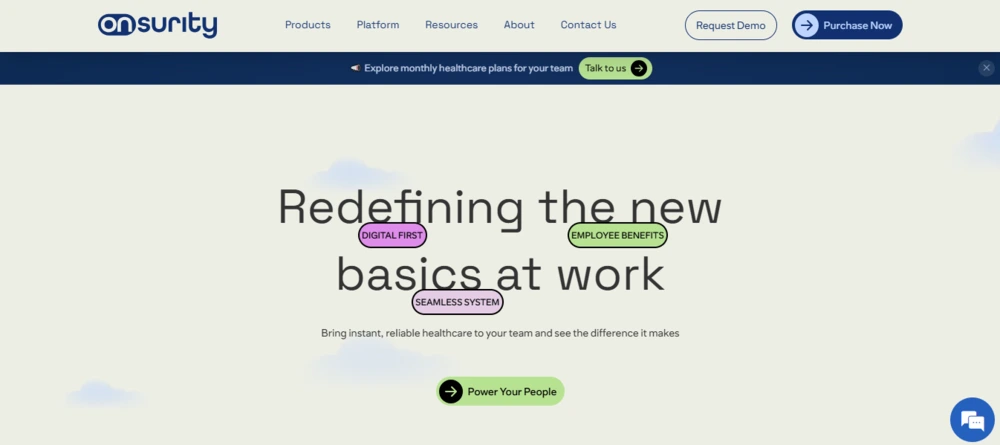
Onsurity has fundamentally redefined employee healthcare by pioneering a flexible, monthly health and wellness membership model with group health insurance built in. Instead of forcing companies to block significant capital in heavy, upfront annual premiums, it lets businesses pay as they go, keeping working capital free, something smaller and growing teams feel directly.
- Minimum team size: Covers teams of as few as 3, and that count can include full-time staff, founders, interns, and freelancers.
- Pricing: Starts at ₹145 per employee per month, with dynamic pro-rata billing that scales automatically with your active headcount.
- What stands out: Day-1 emergency hospitalisation cover pairs with a robust daily wellness stack; discounted fitness memberships through Cult.fit and Fitpass, direct pharmacy discounts on home-delivered medicines, quick lab-test bookings, and mental health support via Amaha. Coverage extends across the whole household too, with the option to add parents, in-laws, spouses, children, siblings, and LGBTQ+ partners. The whole thing is run through an intuitive employee mobile app and seamless central HRMS integrations that automate onboarding and offboarding. The monthly model and the low minimum team size make it a natural fit for remote-first companies that are still scaling.
2. Plum
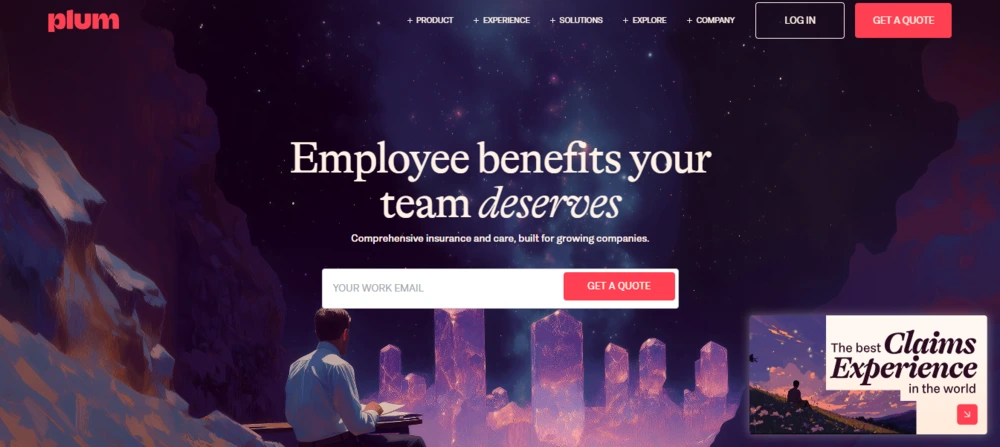
Plum focuses on helping companies construct data-driven corporate health plans. They provide transparent industry benchmarking, allowing you to see what similar businesses offer so you can design a competitive package that stands out in the talent market.
- Minimum Team Size: 7 members (Companies with fewer full-time staff can meet this requirement by including employee family members).
- Pricing: Customized based on selected benefits with a price-match guarantee.
- What stands out: Plum makes it easy to extend coverage to spouses, children, parents, and LGBTQ+ partners. Their app provides direct 24/7 claims guidance, automated HR integrations to sync new hires instantly, and built-in health perks like online consultations and dental care packages.
3. Pazcare
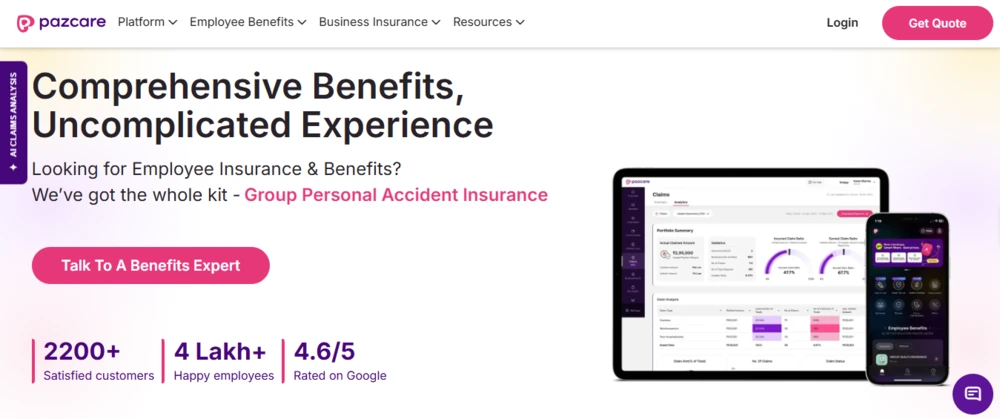
Pazcare is built to strip away the administrative mess of spreadsheets and fragmented email chains. They utilize a modular, mix-and-match system that allows employers to pick precise healthcare perks from a menu, ensuring you only pay for what your distributed team actually uses.
- Minimum Team Size: Requires 5 to 7 employees to initiate a policy.
- Pricing: Tailored entirely to your team size and chosen coverage modules.
- What stands out: Pazcare provides HR teams with a highly visual, single-window dashboard to track live claims status and usage patterns. For remote employees, the mobile app offers a completely paperless ecosystem to file claims, backed by highly responsive customer support boasting an NPS score of over 70.
4. Loop
Loop stands out by blending traditional group health insurance plans with a completely free, in-house primary care model. Their core objective is to focus heavily on preventative medicine to help organizations lower overall healthcare costs over time.
- Minimum Team Size: Standard minimum requirement of 7 employees.
- Pricing: Custom packages designed to potentially reduce traditional premium costs by up to 30%.
- What stands out: Loop provides employees with immediate, unlimited digital access to their internal medical team for routine checkups and medical opinions. The platform also features a robust Employee Assistance Program (EAP) filled with live wellness sessions, mental health counseling, and an interactive “health index” to gamify and track team fitness.
Also Read: Best Group Health Insurance for Startups in India
How to Choose the Right Group Health Insurance for Remote Teams
Choosing a policy for a remote team involves more than just comparing premiums. Since your employees are working from different locations, here are the most important factors to evaluate:
- Start With Your Team’s Real Needs : Assess where your employees live and who they need to cover. A team with older parents will need different coverage limits compared to a team of young Gen-Z professionals.
- Examine the Network Strength: Ensure the insurance provider has a deeply entrenched network of hospitals across all the regions where your remote employees reside.
- Prioritize Tech-Driven Platforms: Look for platforms that offer a seamless mobile app for employees alongside central HR dashboards with easy HRMS integration to add or remove members, view live claims, and track wellness usage data. Ensure they bundle group health insurance with daily benefits like free teleconsultations, fitness resources, mental health support, and pharmacy discounts to give your remote team practical, everyday value.
- Compare more than the premium: Two plans at the same price can be very different once you look at sub-limits, exclusions, and the claim experience. So look beyond the price and check what each plan actually covers.
Also Read: Best Group Insurance Providers in India
Conclusion
A proper group health plan for remote employees is now a basic requirement, not a perk. It protects your team from high hospital bills while helping them manage the everyday burnout of working from home. When your people feel looked after, they stay longer and work better.
If you are looking for a modern, digital-first health solution, Onsurity is the ideal partner. By bundling group health insurance with a robust wellness ecosystem, all managed through a flexible monthly membership and a seamless app, Onsurity helps you look after your remote team without draining your capital.
FAQS
1. How does group health insurance for remote workers differ from traditional corporate plans?
The underlying medical coverage is quite similar, but remote-friendly plans place a much higher focus on digital accessibility. They prioritize features like pan-India hospital networks, instant online doctor consultations, digital claims processing, and remote wellness perks since employees cannot visit a physical office clinic.
2. Are pre-existing diseases covered under remote group health insurance?
Yes. One of the biggest advantages of a corporate group health plan is that pre-existing conditions are covered right from Day 1 of the policy, entirely skipping the multi-year waiting periods found in personal individual health plans.
3. What is the 80 20 rule for health insurance?
The 80/20 rule refers to Co-insurance, which is a cost-sharing model where the insurance provider covers 80% of a medical claim, and the employee pays the remaining 20% out of pocket. In global regulatory contexts, it also refers to the Medical Loss Ratio, which mandates that insurance companies spend at least 80% of premium revenue directly on healthcare claims and quality care, capping administrative overhead and profits at 20%.
4. What is covered in group health insurance?
It primarily covers in-patient hospitalization costs (ICU charges, room rent, nursing fees, and surgeries), day-care procedures, and pre-and post-hospitalization medical expenses (usually for 30 to 60 days). It also features day-one coverage for pre-existing illnesses, and can be customized to include maternity cover and out-patient department (OPD) benefits like online doctor consultations.
Key Takeaways
Remote work is a dream for your team: no commute, more flexibility, and the freedom to work from anywhere. But there’s a flip side that creeps in too, like back and neck pain, eye strain, a sedentary barely-moving routine, poor sleep, burnout and loneliness,
To keep your remote teams healthy and genuinely productive, a group health plan tailored to these modern lifestyle realities is a total game-changer.
Forward-thinking platforms like Onsurity, Plum, Pazcare, and Loop bridge this gap seamlessly by bundling traditional emergency hospital cover with daily digital wellness benefits like online therapy.
Ultimately, adapting your healthcare strategy to fit a remote setup pays you back where it counts: stronger retention, higher productivity, and a workforce that stays motivated and loyal for the long haul.

Senior Executive – Content
Payal specializes in the healthcare, wellness, and insurtech space, with a strong focus on educating businesses about insurance and employee wellbeing. She is passionate about simplifying an industry that is often misunderstood and filled with complex jargon, translating it into clear and practical insights that organizations can easily understand and act on. Through her work, she aims to make the insurance ecosystem more transparent and accessible, helping businesses recognize that prioritizing employee wellbeing is not just a benefit but a responsibility.