
 Payal Agarwal
 March 17, 2026
 8 min read
 230
230Table of Contents
Is your office’s productivity hitting a wall? Have you noticed a cloud of disengagement hanging over your team despite having the best tools and talent? The reason likely isn’t a lack of dedication; it is a surplus of stress.
We are living in an unpredictable and volatile time. Between global war-like tensions, fluctuating energy costs and LPG shortages, and the relentless pace of inflation, your employees are walking into the office already carrying a heavy mental load. While you certainly can’t control geopolitical instability or the price of fuel, you can control the environment and manage stress effectively within your office premise.
A holistic approach to reducing office stress isn’t just a “nice-to-have” HR initiative; it’s a business imperative. Gallup’s State of the Global Workplace 2025 report highlights that 41% of employees under 35 experience daily stress, contributing to broader productivity losses amid economic pressures.
The financial implications of ignoring this trend are staggering. Research shows that burnout costs businesses $322 billion annually in lost productivity. When stress goes unaddressed, it manifests as absenteeism, lower cognitive performance, and high turnover, directly eroding the company’s bottom line.
By addressing the stressors at work, you create a sanctuary of focus amidst a chaotic world. Here is how you can take charge and reduce workplace stress through structural and cultural shifts.
Also read: How to Build a Workplace Wellness Program for Startups?
Top 16 Ways Employers Can Reduce Workplace Stress
Building a resilient workplace requires a comprehensive approach that covers everything from company policy to the physical office layout. The following fifteen strategies are organized into four key categories to help you systematically address and reduce stress across your organization.
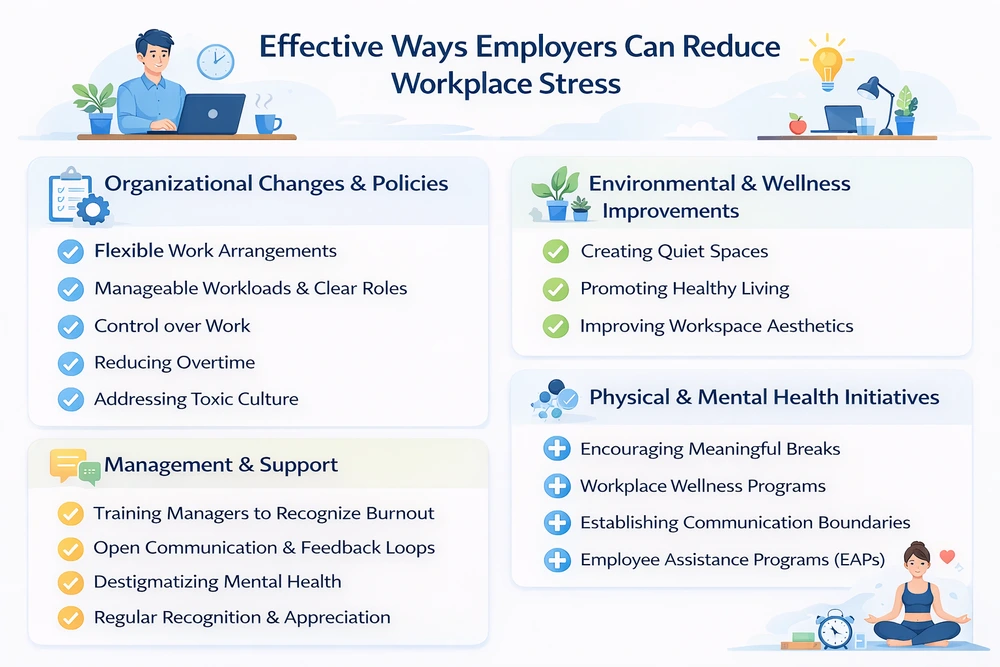
Organizational Changes & Policies
Structural shifts in how a company operates are often the most impactful way to reduce systemic pressure on your team.
1. Flexible Work Arrangements
The rigid 9-to-5 is becoming a relic of the past. Recent data shows that employees with location and schedule flexibility report 39% higher productivity scores. Whether it’s hybrid models, compressed workweeks, or “core hours,” giving your team control over their time is the ultimate stress-reliever.
2. Manageable Workloads & Clear Roles
Ambiguity breeds anxiety. When an employee doesn’t know what “success” looks like or faces an impossible to-do list, they often freeze. Use project management tools to keep workloads realistic and ensure deadlines are actually achievable.
Regularly updating role expectations removes the mental guesswork, allowing your team to focus their energy on high-impact tasks rather than trying to guess your priorities. When the boundaries are clear, people move faster because they aren’t afraid of overstepping or missing a hidden goal.
3. Control over Work
Micromanagement is a leading cause of workplace cortisol spikes. Give your team the “what” (the goal) and let them decide the “how” (the process). Autonomy fosters a sense of ownership and competence, which acts as a natural buffer against stress.
4. Reducing Overtime
Chronic overtime isn’t a badge of honor; it’s a precursor to heart disease and stroke. The World Health Organization has identified long working hours as a major health risk. Beyond the health risks, there is a clear law of diminishing returns: a tired brain makes more mistakes, meaning your team often spends the next morning fixing errors made late the night before.
Set a “hard stop” culture where staying late is the exception, not the rule. Move away from praising “the last one to leave” and start celebrating the employees who manage their time efficiently enough to go home on time.
5. Addressing Toxic Culture
Toxicity in the workplace is a silent drain on productivity and morale. Toxic people who fuel gossip, office politics, and exclusionary behavior create a constant state of anxiety for those around them. Leaders must actively address these behaviors rather than letting them fester.
Prioritizing a culture of radical candor and kindness ensures the office remains a safe space for everyone to contribute. When you eliminate toxicity, you restore the psychological safety necessary for a healthy, high-functioning team.
Suggested read: 12 Ways to Keep Employees Happy and Productive
Environmental & Wellness Improvements
The physical environment plays a silent but powerful role in how employees process stress throughout the day.
6. Creating Quiet Spaces
Offices are naturally full of distractions like ringing phones, loud conversations, and people constantly walking back and forth past desks. This movement and noise make it incredibly hard to maintain focus. You can help your team by providing physical boundaries like cubicles, private pods, or designated Deep Work Zones where talking is not allowed.
Even when everyone is working in the office together, having a guaranteed silent space lets employees escape sensory overload so they can get their most important work done without feeling overwhelmed.
7. Promoting Healthy Living
Move beyond the “fruit bowl in the breakroom.” Offer standing desks, walking meetings, or corporate discounts for local fitness centers. Physical movement is a scientifically proven method to metabolize stress hormones.
8. Improving Workspace Aesthetics
Environment dictates mood. Research into Biophilic Design suggests that adding plants, maximizing natural sunlight, and using calming color palettes (like blues and soft greens) can reduce heart rates and improve cognitive function. Beyond just looking good, a well-designed office acts as a physical buffer against stress. When you replace harsh lighting with warmth and nature, you shift the brain from a state of high-alert into a state of focused calm.
Quick read: Holistic Wellness: Balancing Physical, Mental, and Emotional Health at the Workplace
Management & Support
Effective leadership and strong support systems provide the foundation for a resilient workplace culture.
9. Training Managers to Recognize Burnout
Managers are usually the first to notice changes in their team. By providing training on how to spot early warning signs like withdrawal, irritability, or a sudden drop in work quality, you allow for intervention before an employee hits a breaking point.
This proactive approach ensures that leadership can offer support or adjust deadlines when they see a team member struggling. It moves the focus from reacting to a crisis to preventing one from happening in the first place.
10. Open Communication & Feedback Loops
Stress thrives in the dark. Establish regular 1-on-1s where the focus isn’t just on “status updates” but on how the team member is actually feeling. Utilizing anonymous feedback channels can help identify systemic concerns before they escalate into major organizational problems.
This level of transparency fosters a culture of trust where every team member feels their voice is heard and valued. When communication is clear and open, the entire organization becomes more resilient.
11. Destigmatizing Mental Health
If leadership doesn’t talk about mental health, employees will hide their struggles. Normalize the conversation by sharing mental health resources during all-hands meetings and ensuring that taking a “mental health day” is treated with the same validity as a “sick day.”
12. Regular Recognition & Appreciation
A “thank you” is the most cost-effective retention tool in your arsenal. Gallup’s 2024 research with Workhuman shows employees receiving high-quality recognition are 45% less likely to leave within two years. Publicly celebrate wins to remind your team that their effort matters.
Suggested read: Employee Rewards and Recognition
Physical & Mental Health Initiatives
Providing direct wellness resources gives employees the practical tools they need to stay healthy and productive.
13. Encouraging Meaningful Breaks
The human brain can only focus intensely for about 90 minutes before needing a reset. Encourage “micro-breaks”, five minutes to stretch or get coffee and lead by example. If the boss never leaves their desk, the employees won’t either.
14. Workplace Wellness Programs
Modern wellness goes beyond basic insurance. Consider offering subscriptions to meditation apps, on-site yoga, or financial literacy workshops. By offering support for the external pressures that often follow people into the office, you allow employees to remain focused and productive during work hours. This approach fosters long-term stability and a more supportive organizational culture.
15. Establishing Communication Boundaries
The “always-on” culture is a direct path to burnout. Implement a “No-Slack/No-Email” policy after 7:00 PM and on weekends. Respecting the “Right to Disconnect” allows employees to truly recharge, ensuring they return on Monday with full batteries.
16. Employee Assistance Programs (EAPs)
Providing access to an EAP offers employees a confidential way to deal with personal or work-related challenges that may impact their job performance or health. These programs often include short-term counseling, assessments, and follow-up services for issues ranging from substance abuse to emotional distress.
By making these services readily available, you give your team a professional safety net to lean on during difficult times, ensuring they don’t have to navigate complex personal struggles alone.
Also read: 10 Ways to Improve Mental Health at the Workplace
Conclusion
Taking care of your employees is the best way to take care of your business. When you lower the stress ceiling, your team naturally raises the performance floor. Healthtech platforms like Onsurity help facilitate this by providing the specific resources your people need to stay healthy and resilient.
Through Onsurity, your team gets access to discounted gym memberships to stay active and doctor teleconsults for medical advice at their fingertips. To support emotional health, they provide professional counseling through Amaha and host mental health workshops to give employees the tools to manage pressure effectively. Additionally, discounted health checkups help your team stay ahead of potential issues before they become serious. By integrating these benefits, you ensure your employees are supported and valued, allowing them to bring their best selves to work every day.
Start by picking three strategies from this list to implement this quarter, and watch your team’s engagement transform.
FAQs
1. Why should employers prioritize reducing workplace stress?
Prioritizing stress reduction is essential because chronic pressure directly impacts a company’s bottom line. When employees are overwhelmed, productivity drops and the risk of burnout increases, leading to higher turnover and absenteeism. By creating a supportive environment, businesses can foster higher engagement, improve retention, and ensure that their team remains mentally sharp and capable of high-quality work.
2. What are some common sources of workplace stress that employers should address?
Common stressors often include heavy workloads, tight deadlines, and a lack of clarity regarding job roles. Environmental factors like constant noise and frequent interruptions also play a significant role. Additionally, organizational issues such as poor communication or a lack of autonomy can make employees feel undervalued and restricted, further contributing to their overall stress levels.
3. How can effective leadership contribute to a less stressful work environment?
Leaders set the tone for the entire organization. By practicing open communication and providing regular, constructive feedback, managers can eliminate the uncertainty that often causes anxiety. Effective leaders also lead by example, showing their teams that it is acceptable to take breaks and disconnect after hours. This builds a culture of trust where employees feel safe to voice concerns before they turn into major problems.
4. How can employers promote a healthy work-life balance to reduce stress?
Employers can promote balance by offering flexible work arrangements such as hybrid schedules or flexible start and end times. Encouraging employees to fully use their paid time off and establishing clear boundaries regarding after-hours communication are also vital steps. When an organization respects an individual’s personal time, employees return to work more refreshed and focused.
5. How can the physical work environment impact stress levels?
The physical space has a profound effect on mental well-being. Poor lighting, uncomfortable furniture, and a lack of quiet areas can lead to physical fatigue and sensory overload. On the other hand, an office that incorporates natural light, ergonomic equipment, and dedicated zones for deep focus can significantly lower heart rates and improve cognitive function.
6. How can employers measure the effectiveness of their stress reduction initiatives?
Effectiveness can be measured through a combination of qualitative and quantitative data. Regular anonymous surveys and feedback sessions allow employees to share their experiences safely. Employers can also track key metrics such as turnover rates, the number of sick days taken, and overall participation in wellness programs. A consistent improvement in these areas generally indicates that the stress reduction strategies are working.

Senior Executive – Content
Payal specializes in the healthcare, wellness, and insurtech space, with a strong focus on educating businesses about insurance and employee wellbeing. She is passionate about simplifying an industry that is often misunderstood and filled with complex jargon, translating it into clear and practical insights that organizations can easily understand and act on. Through her work, she aims to make the insurance ecosystem more transparent and accessible, helping businesses recognize that prioritizing employee wellbeing is not just a benefit but a responsibility.