 Payal Agarwal
 January 30, 2026
 9 min read
 317
317Table of Contents
Employee Rewards
Silence is often the most expensive mistake a leader can make. According to the Gallup State of the Global Workplace: 2026 Report, global employee engagement is currently sitting at a low 21%. This lack of connection isn’t just a morale issue; it translates to roughly $438 billion in lost productivity every year.
When your team puts in the hours, meets the deadlines, and goes above and beyond, they need to know their effort actually matters. This is where rewards and recognition programs come into play. Rewards are a bridge between hard work and job satisfaction. By offering real value in return for excellence, you can make employees feel recognized and valued. Whether it is through performance ratings, appraisals, or meaningful benefits, you are effectively telling your team that their contribution is the engine of your success.
When people know they are appreciated, they naturally feel more energized to do their best work. For any employer, this is the secret to building a truly engaged team. A simple “thank you” or a well-timed bonus can transform a stagnant office into a hub of innovation.
What Are Employee Rewards?
While often used interchangeably, rewards and recognition are two sides of the same coin.
Employee Rewards are typically tangible or transactional. They are the benefits or “prizes” given to an employee for reaching a specific goal or milestone. These can be monetary, such as bonuses and gift cards, or non-monetary, such as extra vacation days or wellness memberships.
Employee Recognition is more relational and emotional. It is the act of acknowledging an employee for who they are and what they contribute. This can be a shout-out in a meeting, a personalized note, or a public post on LinkedIn.
When you combine both, you create a robust “Rewards and Recognition” (R&R) strategy. Rewards provide the “what,” and recognition provides the “why.” Together, they satisfy the human need for both security and belonging.
Also read: Employee Benefits in India
How Rewards and Recognition Powers Business Growth
Treating Rewards and Recognition (R&R) as a “soft” HR expense is a mistake in 2026. When appreciation is woven into your culture, it stops being a discretionary perk and starts driving measurable business results.
Here is how strategic recognition impacts your core objectives:
1. Boosting Productivity and Profit
Recognition is a performance multiplier. When employees feel their work is truly seen, they bring more “discretionary effort” to their tasks. According to a study, teams with high engagement see an 18% increase in productivity and a 23% boost in profitability. It creates a feedback loop where high performers feel motivated to keep their momentum.
2. Improving Retention and Talent Stability
Replacing a skilled employee can cost up to twice their annual salary. In the current competitive job market, staying recognized often means staying put. Data from Achievers shows that companies with mature recognition programs have 31% lower voluntary turnover. When people feel valued, they are 17 times more likely to see a long-term career path within your organization.
3. Strengthening Customer Relationships
There is a direct link between employee happiness and customer satisfaction. When people feel genuinely valued, they are much more likely to approach their work with a sense of ownership and care. It is difficult to provide great service if you do not feel great about where you work. Research shows that companies with the highest engagement levels see a 10% increase in customer loyalty. Essentially, the respect and appreciation you show your team is exactly what they will pass on to your clients.
Suggested read: 10 Best Employee Engagement Tools and Software
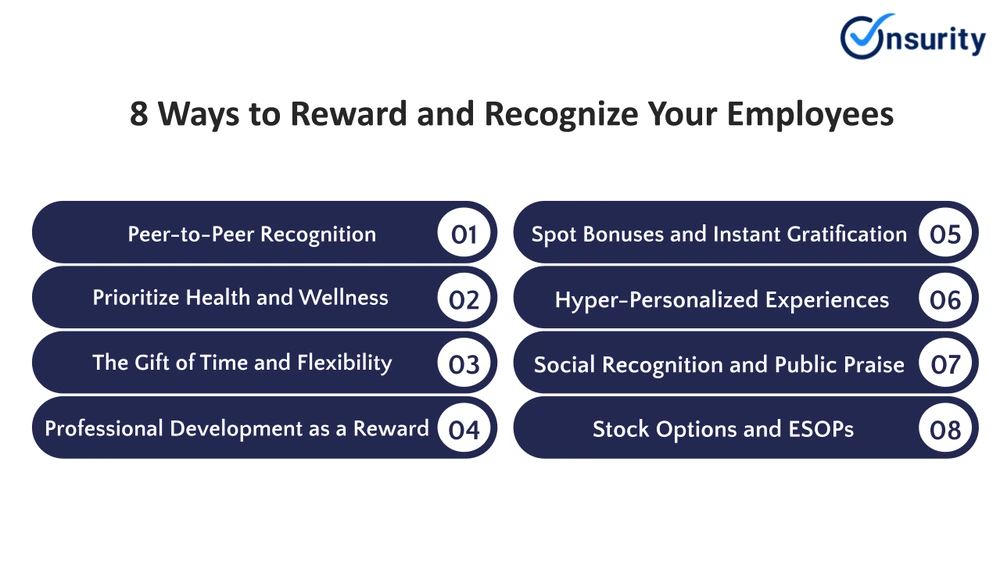
8 Powerful Ways to Reward and Recognize Your Employees
To bridge the recognition gap, you need a mix of instant, social, and long-term rewards. Here are eight effective strategies to implement in your organization.
1. Peer-to-Peer Recognition and Digital Shout-outs
Manager feedback is essential, but recognition from the people you work with every day carries a different kind of weight. Your colleagues are right there in the trenches with you. They notice the small saves and the extra effort that a manager might naturally miss.
The 2025 Achievers Engagement Report shows that employees who get peer-to-peer recognition are 2.4 times more likely to feel a strong sense of belonging at work. By using digital platforms or dedicated Slack and Microsoft Teams channels, you give everyone the power to send “kudos” or points to one another. This democratizes the process and ensures that appreciation flows in all directions, not just from the top down.
2. Prioritize Health and Wellness
Today, people often value their physical and mental health as much as their salary. Rewarding your team with wellness benefits shows you see them as human beings rather than just workers. It moves the relationship beyond just a paycheck and shows you actually care about their lives.
Recent data from Forbes Advisor highlights that 40% of employers believe workers leave specifically to find better benefit packages. This is where Onsurity makes things easy. You can provide your team with monthly healthcare memberships that include preventive care, discounted medicines, and lab tests. When you invest in your employees’ well-being this way, you build a level of trust that a one-time cash bonus simply cannot buy.
3. The Gift of Time and Flexibility
Time has become the most valuable currency in the 2026 workplace. After years of hybrid work, employees have realized that flexibility is the ultimate perk.
A Deloitte 2025 Digital Workforce study found that 94% of professionals would benefit from work flexibility, and one-third would take a pay cut for more control over their schedule. Consider “Early-Out Fridays” or “Wellness Wednesdays” where the afternoon is meeting-free. Giving an employee an extra day off or a “work from anywhere” week acts as a powerful motivator that prevents burnout and acknowledges that their time outside of work is sacred.
4. Professional Development as a Reward
High-performing employees are driven by growth. For them, a “reward” isn’t a gift card; it’s a path to their next promotion. Rewarding a top performer with a certification course, a seat at a major industry conference, or a mentorship session with a top executive is a “win-win.”
Research from LinkedIn’s 2025 Workplace Learning Report shows that 72% of employees say the most important factor in their job satisfaction is the opportunity to learn and grow. By investing in their skills, you show the employee that you see a long-term future for them in the organization, which significantly reduces the “itch” to look for opportunities elsewhere.
Quick read: Top 10 HR Metrics to Improve Employee Experience
5. Spot Bonuses and Instant Gratification
Delayed recognition is often ineffective. If an employee completes a massive project in January, waiting until their December appraisal to reward them feels impersonal. Spot awards or instant gift cards provide immediate positive reinforcement. 77.9% of employees say they would be more productive if they received recognition more frequently. The speed of the reward makes the employee feel seen in the moment.
6. Hyper-Personalized Experiences
The “one-size-fits-all” approach to gifting is officially a thing of the past. In 2026, the most impactful rewards are hyper-personalized. A sports fan might value tickets to a game; a home chef might prefer a high-end cooking class.
Taking the time to learn about your employees’ hobbies through brief surveys makes the recognition feel much more authentic. Personalized rewards create a deeper emotional connection and reinforce the behaviors that help your company reach its goals.
7. Social Recognition and Public Praise
Most people appreciate being seen. While some prefer a quiet word of thanks, many feel a significant boost in morale when their work is celebrated in front of the group. Being praised among peers builds a sense of pride and belonging that a private email simply cannot replicate.
You can use company Slack channels, internal newsletters, or monthly town halls to highlight specific wins. A LinkedIn recommendation from a CEO or senior leader is another high-value social reward. It adds permanent credibility to an employee’s professional profile. This ensures the gesture continues to provide value long after the initial shout-out.
8. Stock Options and ESOPs
Giving top performers a stake in the company’s future breeds deep commitment. Stock options or ESOPs grant staff the right to buy company shares at a discount. If the company succeeds, their financial reward grows. Data from the NCEO shows that ESOP companies have voluntary quit rates at roughly one-third of the national average, proving that when employees think like owners, they stay like owners.
Also read: Top 11 Health and Wellness Gifts for Your Employees
Conclusion
Employee rewards and recognition are no longer “optional extras.” They are essential business strategies for the 2026 landscape. When you acknowledge hard work, you are reinforcing the behaviors that drive your company’s success. The goal is simple: recognize good work, energize your team, and watch your business grow.
A critical part of this strategy is ensuring your team is physically and mentally fit to perform. This is where Onsurity makes a difference. By providing comprehensive health and wellness benefits, such as discounted Cult.fit passes, free doctor checkups, discounted medicines, and lab tests, you show your employees that you are genuinely invested in their lives.
Beyond physical health, Onsurity offers mental health workshops and one on one counselling, addressing the burnout that often plagues high-performance cultures. When you provide these tools, your team feels protected and valued, making wellness one of the most impactful rewards you can offer.
FAQs
1. What is employee reward and recognition?
Employee reward and recognition is the system a company uses to acknowledge hard work and celebrate excellence. Rewards are usually the tangible things you give, like bonuses or gift cards. Recognition is the act of noticing and praising someone’s contribution. Together, they show your team that their effort actually matters.
2. Why is employee reward important in the workplace?
When employees feel ignored, they disengage. Strategic rewards build a sense of belonging and motivate people to keep performing at a high level. It is one of the most effective ways to lower turnover and boost overall productivity.
3. What are the types of employee rewards?
Most rewards fall into two buckets. Monetary rewards include bonuses, raises, spot awards, and stock options. Non-monetary rewards involve extra time off, flexible work hours, public praise, or professional development opportunities. A good program usually offers a mix of both.
4. What is the difference between reward and recognition?
Rewards are transactional and tangible; you hit a goal, and you get a bonus. Recognition is relational and emotional; it is about being seen and appreciated for your unique skills or effort. Rewards satisfy the wallet, while recognition satisfies the person.
5. How to measure the success of employee rewards and recognition programs?
Measuring success means looking at more than just a feeling. You should track retention rates to see if voluntary turnover is dropping and use employee NPS (eNPS) surveys to see if people actually feel valued. Additionally, check if performance metrics are improving. If the numbers are moving up and people are staying longer, your program is doing its job.
6. Can small businesses benefit from rewarding employees?
Absolutely. In fact, for small businesses, rewards are often even more critical because every team member’s impact is so visible. You don’t need a massive budget to make it work; small, thoughtful rewards like flexible hours or personalized “thank yous” can build a culture of loyalty that helps a small team punch way above its weight.
7. What are some examples of employee rewards?
Examples range from financial incentives like performance bonuses and profit-sharing to lifestyle rewards like team lunches, extra vacation days, or professional development courses. Even smaller gestures, like a personalized gift card or a flexible “work from anywhere” day, can make a big impact.

Senior Executive – Content
Payal specializes in the healthcare, wellness, and insurtech space, with a strong focus on educating businesses about insurance and employee wellbeing. She is passionate about simplifying an industry that is often misunderstood and filled with complex jargon, translating it into clear and practical insights that organizations can easily understand and act on. Through her work, she aims to make the insurance ecosystem more transparent and accessible, helping businesses recognize that prioritizing employee wellbeing is not just a benefit but a responsibility.