 Onsurity Editorial
 January 13, 2026
 18 min read
 538
538Table of Contents
Why Choosing the Right Health Insurance Plan Matters
Healthcare benefits have become a core part of employee experience. The plan you choose will influence your employee satisfaction, retention, and trust, so it’s important that there are no surprises or confusing clauses that catch your team off guard. But we all know how tricky and jargon-heavy health insurance terms can be, so understanding them makes it easier to compare plans and choose benefits that genuinely protect people.
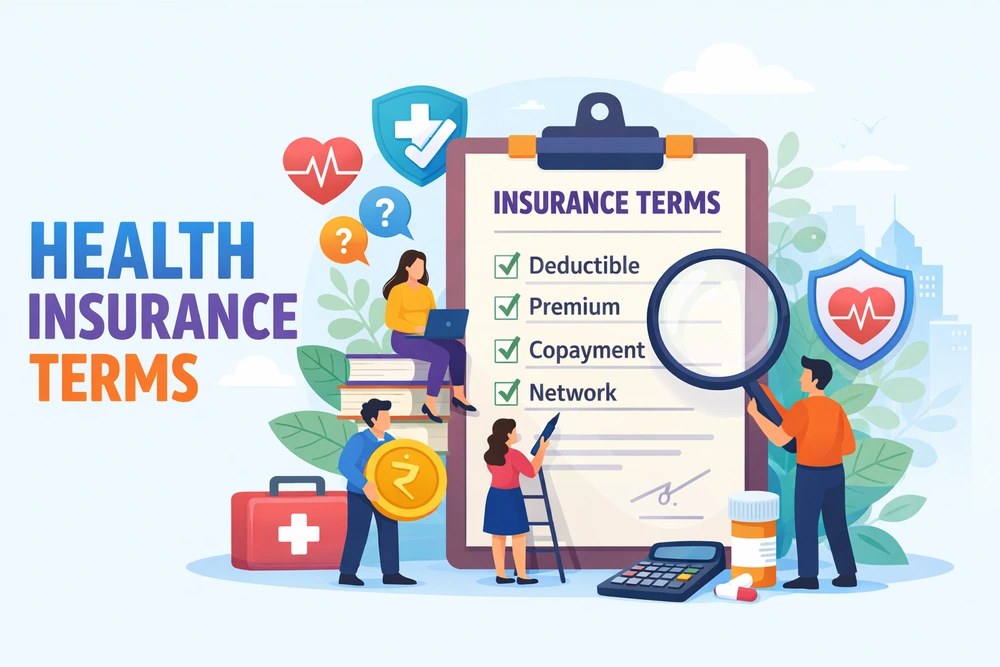
In this blog, we have curated a list of 45 health insurance terms that you and your employees must know before activating coverage.
45 Health Insurance Terms Every Employer Should Know
1. Add-ons or Riders
2. AYUSH Coverage
3. Adjudication
4. Beneficiary
5. Cashless Claim
A cashless claim covers hospitalization expenses of the covered member at the time of hospitalization. The hospital bill is settled directly between the hospital and the insurance provider immediately. The process is coordinated through the TPA or insurance desk at the hospital, so the member does not have to pay the bill upfront. Cashless claims are not available at every hospital; they are only available at network hospitals.
6. Claim Settlement Ratio
The claim settlement ratio tells you how many claims an insurer has paid compared to how many were filed. If an insurer has a high settlement ratio, it usually means smoother claim handling and higher reliability.
7. Co-payment (Co-pay)
In a co-pay plan, the insurer pays a portion of the claim amount, and the policyholder pays the remaining portion. The co-pay percentage is not fixed by any rule and is decided by the insurer while designing the plan. In India, the co-pay percentage usually ranges from 10% to 30% of the total medical expenses, while the insurer pays the balance claim amount.
Employers can choose whether to offer a co-pay plan and select the percentage based on what works best for their team. Some insurance plans give the option of co-pay because it helps bring the premium down.
8. Coverage Amount or Sum Insured
Sum insured is the total policy amount available for a policy year. It is not the maximum amount for one treatment, but the overall amount the policyholder can use during the year. This amount is mainly meant for hospitalization-related expenses, but the full sum insured may not always be usable because of policy conditions like limits, exclusions or co-pay.
9. Critical Illness Cover
Critical illness cover is usually added as a rider to a group health insurance policy to make the coverage more enhanced and inclusive. It is commonly opted for when employers are covering parents, employees who may be more susceptible to serious illnesses, or where there are pre-existing conditions.
If the insured person is diagnosed with a critical illness such as cancer, heart attack, stroke, or kidney failure, this cover provides a fixed lump sum payout. Unlike regular health insurance, this amount is paid on diagnosis and is not linked to hospital bills. The money can be used for treatment, long-term care, recovery needs, or to manage expenses if the person is unable to work.
10. No Claim Bonus
If a policyholder does not make any medical claims during the policy term, they are rewarded with a no-claim bonus for not utilizing the coverage amount. The no-claim bonus usually ranges as a percentage of the sum insured and can differ from policy to policy. In most cases, it is offered as an increase in the sum insured without increasing the premium, and in some plans, it may also help reduce the premium at renewal. No claim bonus helps improve overall coverage over time.
11. Daycare Procedures
Daycare procedures are medical or surgical treatments that require hospitalization but are completed within 24 hours due to medical advancement. These procedures require hospital infrastructure and are usually done under general or local anaesthesia. Earlier, such treatments would have required inpatient care for more than 24 hours. OPD consultations or diagnostic-only procedures are not considered daycare procedures.
12. Deductible
A deductible is the fixed amount that the policyholder needs to pay first before the insurance starts covering medical expenses. Once this deductible amount is paid, the insurer pays the remaining eligible claim amount as per the policy.
For example, if the deductible is ₹2 lakh and the hospital bill is ₹5 lakh, the policyholder pays the first ₹2 lakh, and the insurer covers the remaining ₹3 lakh. Deductibles are commonly seen in top-up and super top-up plans and help reduce the overall premium.
13. Dependent Coverage
Most health insurance plans also allow coverage for dependents. When employers buy a group health insurance plan, they can choose to include dependents of employees based on the team’s needs. Dependents usually include family members like spouses, children or parents. This is a good-to-have benefit because it helps employees take care of their family’s healthcare needs under one plan, which reduces stress and out-of-pocket expenses during medical emergencies.
With Onsurity, employers can offer dependent coverage and even include in-laws and siblings, making the plan more inclusive and valuable for the entire family.
14. Disease Sub limit
Disease-wise sub-limits are caps placed on specific illnesses or treatments within a health insurance policy. This means that even if the total sum insured is high, the insurer will only pay a fixed amount for certain procedures. Any cost beyond this limit has to be paid by the employee. These sub-limits act as internal restrictions within the policy and can significantly reduce the actual claim amount, which is why it is important to check policy terms carefully.
15. Domiciliary Treatment
Domiciliary treatment refers to medical care given at home when hospitalization is not possible or advised by a doctor. This benefit covers treatment that would otherwise require hospital admission, even though it is provided at home.
With Onsurity, domiciliary treatment is included as a default benefit in group health plans, so your employees are covered even when care needs to be given at home.
16. Exclusions
Exclusion is basically services or benefits that are not covered under the scope of the policy. While every health insurance plan has exclusions, group health insurance plans are usually more inclusive, and employers can choose broader coverage with fewer restrictions. Common exclusions may include cosmetic procedures, self-inflicted injuries, or experimental treatments.
With Onsurity, employers can offer plans with minimal exclusions and coverage that start from day one.
17. Floater Coverage
Floater coverage is a type of health insurance where multiple family members are covered under a single policy with one shared sum insured. Instead of buying separate policies for each person, a family floater allows all members to use the same coverage amount. This helps bring down the overall premium and makes the policy more cost-effective compared to individual plans.
18. Free Look Period
It is a 15- to 30-day period to review the policy after you receive it. If something seems unclear or incorrect, you can request a cancellation during this time and get a refund.
19. Group Health Insurance
Group health insurance is a single health policy purchased for a group of people. This group can be a formal group, like employees of a company or a non-formal group, such as an association, society, or any group formed with a common purpose. In policy terms, any group with a valid common link can be considered eligible. Group health insurance usually comes with better benefits, minimal paperwork, and lower premiums because the risk is spread across multiple members.
20. Grace Period
If the renewal date is missed, insurers usually provide a short grace period to pay the premium. During this time, claims may not be allowed, but the policy does not expire right away.
21. Insurer
An insurer is a company licensed by IRDAI to provide insurance coverage and settle claims. Insurers can be general insurance companies, which offer health along with other types of insurance, or standalone health insurance companies that focus only on health insurance. While insurance may be sold through brokers or agents, the insurer is the entity that underwrites the policy, defines the coverage terms, and pays the claim amount when a valid claim is made.
22. Inclusions
Inclusions are the list of all the treatments, benefits and services the policy covers.
Always check this while comparing two plans.
23. Network Hospitals
Network hospitals are hospitals that have partnered with the insurer to provide cashless treatment.
More network hospitals mean easier access for your team.
24. Non-Network Hospitals
Non-network hospitals are hospitals that are not part of the insurer’s cashless network but still fall within the scope of coverage. If a policyholder takes treatment at a non-network hospital, they will have to pay the treatment cost upfront. The claim can then be filed later as a reimbursement, where the insurer pays back the eligible amount after document verification, as per the policy terms and timelines.
25. Non-Payment Clause
A non-payment clause explains the situations in which an insurance claim may not be paid by the insurer. This can happen if the claim does not meet policy terms, required documents are missing, or if the claim is found to be fraudulent.
If a claim is rejected and the policyholder feels it is unfair, they can raise a grievance with the insurer. If the issue is still not resolved, the policyholder can approach insurance grievance bodies in India, such as the insurer’s grievance cell or the Insurance Ombudsman, who review the case and help ensure that genuine claims are processed correctly.
26. Nominee
A nominee is the person authorized to act on behalf of the insured during a health insurance claim. They can help submit documents and coordinate the claim process if the insured is unable to do so due to serious illness or hospitalization.
In reimbursement of claims, the nominee may receive the claim amount on behalf of the insured. In group health insurance, the nominee’s role is mainly to assist with claims and is different from nominee roles in personal accident or term life insurance, where lump-sum payouts are involved.
27. OPD Benefit
It basically provides coverage for OPD visits, such as doctor consultations, diagnostic tests, and medications that do not require hospital admission.
Some insurers have OPD benefits as a part of the inclusion; however, most policies come without it. Employers, when purchasing group health insurance from Onsurity, can add OPD benefits to their existing policy
28. Out-of-Pocket Expenses
Any amount the employee pays because the policy does not cover it or because a limit has been crossed.
29. Override or Policy Amendment
A policy amendment or override means making changes to an existing group health insurance policy after it has started. Employers usually request amendments when there is a change in team size, when new employees or dependents are added, or when additional benefits like maternity or OPD are required. Amendments are not automatic and must be approved by the insurer, as they may affect risk and premium.
Most insurers allow amendments during the policy term, but they are typically processed within a defined timeline, usually a few working days, depending on the nature of the change. Some amendments may lead to an increase or adjustment in the premium, while others are allowed without cost if they fall within the agreed policy terms.
30. Pre-existing Disease (PED)
Pre-existing diseases refer to health conditions that a covered insured member already has before the health insurance policy starts. Depending on the policy, some of these conditions may be included or excluded from the scope of coverage or covered after a waiting period. Common examples of pre-existing diseases include diabetes, high blood pressure, asthma, and thyroid conditions.
Group health insurance policies through Onsurity ensure that pre-existing diseases are covered from day one, giving employees and their families immediate access to care without long waiting periods.
31. Premium
A premium is the amount paid to keep a health insurance policy active. Premiums can increase year on year based on factors like coverage chosen, claim history, age profile, and add-ons. Employers and policyholders can manage premium costs by selecting the right coverage, reviewing add-ons carefully, and maintaining a healthy claims experience.
In India, premiums paid by employers for employee health insurance are treated as a business expense and are deductible while calculating taxable income. This makes offering health insurance a tax-efficient way for employers to invest in employee benefits.
32. Policy Term
The duration for which the insurance plan remains valid.
Group health plans usually run for one year and are renewed annually.
33. Portability
Portability allows a policyholder to switch from one health insurance policy to another without losing benefits like reduced waiting periods. However, group health insurance policies themselves are not portable. When an employee leaves an organization, they may be allowed to convert their group’s health insurance into an individual policy, subject to insurer terms and timelines.
34. Room Rent Limit
The room rent limit is the maximum amount a health insurance policy will pay for a hospital room during hospitalization. If an employee chooses a room that costs more than this limit, the insurer may pay a lower portion of the total hospital bill, and the remaining amount has to be paid by the employee. This can increase out-of-pocket expenses even when the total bill is within the sum insured. With Onsurity, there is no room rent limit, helping employees avoid unexpected costs during treatment.
35. Reimbursement Claim
A reimbursement claim is when an employee takes treatment at a non-network hospital, pays the hospital bill upfront, and later submits the required documents to get the eligible amount reimbursed by the insurer as per the policy terms.
Onsurity has the fastest reimbursement claims process, where reimbursements have been settled within 6–7 days.
36. Renewal
Renewal means continuing the health insurance policy for the next policy year, so the team remains protected without any break in coverage. Renewing on time helps employees retain benefits like coverage continuity, waiting period credits, and access to network hospitals. If a policy is not renewed on time, coverage may lapse, which can affect claims and benefits.
37. Reinstatement of Cover
If the sum insured gets used early in the year, reinstatement refills the amount so the employee can claim again.
38. Entry Age
Entry age is the age at which a person becomes eligible to buy a health insurance policy. Most health insurance plans have a minimum entry age of around 91 days, and many plans do not have an upper age limit.
39. Sub limits
Sub-limits are caps that the insurer places on specific parts of the policy, such as certain diseases, surgeries, maternity, room rent or even ambulance charges. This means you may have a high sum insured, but the payout for a particular treatment might still be restricted.
For example, a 10-lakh policy may only allow ₹2 lakh for a spine surgery due to a disease-wise cap. Always check sub-limits carefully because they can reduce the actual amount your team receives during claims.
40. Super Top-Up Plan
A super top-up gives extra coverage once your deductible amount is crossed. Unlike a regular top-up, it considers the total of all hospital bills in a year, not just one claim. This makes it a cost-effective way to increase overall protection for your team without paying a very high premium.
With Onsurity, employers or employees can opt for a super top-up plan as an add-on at an extra cost. Employees who already have a group health insurance plan can choose to enhance their coverage and avail more comprehensive treatment if required.
41. TPA (Third Party Administrator)
A TPA is a service partner appointed by the insurer that acts as a mitigator between the hospital and the insurer. It helps manage claims, documents, and approvals, and supports employees during cashless and reimbursement of claims. What sets Onsurity apart is its Good Doctors team.
This is a team of qualified, practicing doctors who actively support employees during hospitalization. They help explain medical procedures, guide employees through the claims process, coordinate with hospitals when needed, and step in to resolve claim-related issues. Having real doctors involved ensures faster decisions, better clarity, and a smoother, stress-free claims experience for employees.
42. Teleconsultation
Teleconsultation allows employees to consult doctors through phone calls or video, without visiting a clinic or hospital. It is helpful for quick medical advice, follow-ups, and minor health concerns. With Onsurity, employees get up to 5 free teleconsultations, making it easier to access medical guidance anytime without added cost.
43. Underwriting
Underwriting is the process where the insurer evaluates the group’s overall risk before issuing a health insurance policy. This includes reviewing factors such as the size of the group, age distribution, past claim history, industry type, and coverage requirements.
Based on this assessment, the insurer decides the premium, coverage structure, exclusions if any, and policy terms. In group health insurance, underwriting is done at a group level rather than for individual employees, which usually results in broader coverage and more flexible terms compared to individual policies.
44. Waiting Period
A waiting period is the time an insured person must wait before certain illnesses, treatments, or conditions become eligible for claims under the policy. Waiting periods are commonly applied to pre-existing diseases, specific treatments, or maternity benefits.
During this period, claims related to these conditions are not allowed. With Onsurity, coverage for employees starts from day one, helping teams access healthcare benefits immediately without long waiting periods.
45. Wellness Benefits
Extra services like health checkups, mental well-being support, fitness programs, and preventive care programs. These wellness benefits help your team stay healthy throughout the year, not just during illness.
Final Checklist for Employers Before Buying an Employee Health Insurance Plan
1. Premium
Premium is the first thing you look at, but it should never be the only thing. A low premium usually means the insurer has added co-pays, sub-limits or restrictions somewhere else. Always ask what exactly is included in the premium and what trade-offs come with a cheaper plan.
2. Coverage
Go beyond the headline sum insured and check what the plan genuinely covers. Look at hospitalization, OPD, maternity, ambulance charges, and daycare procedures. The two plans may both say, “5 lakh cover,” yet offer completely different levels of protection. The difference lies in the details: which procedures are included, how many daycare treatments are covered, what the cap on ambulance charges is, and whether OPD is part of the package.
A strong plan covers a wide range of situations without making employees fight over technicalities. Always read the inclusions list fully because this is what decides whether the policy actually works in real life. Good coverage means fewer surprises for employees during claims.
3. Waiting Period
Many teams assume coverage begins from day one, but that is not always true. Certain illnesses, especially pre-existing diseases or lifestyle conditions, might only be covered after a waiting period. If your workforce includes people with diabetes, asthma or thyroid issues, long waits can create frustration when they need care immediately.
Look for plans with reduced waiting periods for groups or ones that offer credit based on previous insurance history. The goal is to make the benefits usable as soon as possible, not months later when the employee has already struggled.
4. PED Conditions
Preexisting diseases are extremely common, especially in growing teams with employees above 30. Some insurers cover PEDs from day one under group plans, while others impose restrictions or allow only partial claims in the first year.
It is crucial to know exactly how your insurer defines a PED and how it impacts claim eligibility. Even simple conditions like hypertension fall under PED in many policies. The fewer the restrictions here, the smoother the claim experience and the more your employees trust the benefit you are offering.
5. Room Rent Clause
The room rent limit is one of the most important and most overlooked parts of any policy. If the limit is lower than the average private room cost in your city, every other hospital charge can increase proportionally. That means even if the bill fits inside the sum insured, employees may still have to pay a significant portion themselves.
You can check any hospital website to see actual room rates and match them against the policy limit. Ideally, choose a plan with no room rent limit or one that aligns with real hospital pricing to avoid unpleasant surprises.
6. Add-ons
Add-ons are optional benefits you can attach to the main policy to make it more relevant for your team. They cover needs that the base plan usually misses, such as maternity, OPD, dental care, mental health support, or wellness programs. Different teams value different things.
For example, younger teams may look for mental wellness or OPD, while teams with growing families may need maternity. The purpose of add-ons is to fill real gaps in the base policy and provide extra support where your employees need it most, while still keeping the overall cost manageable.
7. Hospital Network Strength
Cashless treatment is the most meaningful part of insurance for employees, and it depends entirely on whether the insurer has strong network hospitals in your city. A big-sounding national network does not matter if the hospitals your employees prefer are missing.
Always ask for the list of network hospitals and check your top three cities manually. A strong network makes emergencies smoother, avoids reimbursements, and reduces stress on employees and HR. Good networks are an indicator of how well the insurer handles real-world healthcare experiences.
8. Claim Settlement Experience
Everything looks good on brochures until the moment a claim is filed. Some insurers approve pre-authorizations within minutes, while others take hours. Some offer transparent communication throughout the treatment, and some keep both HR and employees in the dark.
Ask how long pre-approvals usually take, how quickly reimbursement claims are paid, and what support the insurer provides during emergencies. A plan with quick, fair and consistent claim settlement will always outperform one with impressive benefits but poor service. Claims are where trust is built or broken.
Conclusion
When you understand health insurance terms clearly, choosing the right protection for your team becomes much easier. You know what to avoid, what to prioritize, and how to make sure your employees actually get the support they expect during medical needs. A well-informed decision today can save your team from stress, confusion, and unexpected expenses tomorrow.
If you are looking for a simpler way to offer healthcare benefits without navigating everything alone, Onsurity’s health and wellness membership can help. Our plans are designed to remove the usual confusion around health insurance, offering group insurance through our trusted insurance partners, flexible room rent options, strong hospital networks, wellness benefits, and transparent coverage that your team can rely on. Along with these plan benefits, members also get access to preventive care tools and doctor consultations, all within a digital-first experience that makes healthcare simple and accessible for your entire organization.
With Onsurity, you are giving your team a complete healthcare support system that helps them stay healthy, feel cared for, and get the right assistance when they need it most.
Request a Demo to see how Onsurity can help you transform employee healthcare for your organization.
FAQs
1. What are the most important health insurance terms employers should know?
2. What is a waiting period in health insurance?
3. What does co-payment mean in health insurance?
Co-payment just means your employees pay a part of the medical bill, and the insurer pays the rest. So, if the co-pay is 20%, whatever the final approved bill is, 20% comes from your employee and the rest is handled by the insurer.
4. What does ‘sum insured’ mean for employees?
It’s simply the total amount the plan can pay for hospitalization in a year. So, if the sum insured is 5 lakhs, that’s the max the insurer will cover for approved treatments during that policy period.
5. What is the difference between group health insurance and individual health insurance?
Group insurance is something you give your employees as part of their benefits, and it’s usually easier to join because there are no medical tests, and the coverage starts quickly. Individual insurance is bought personally and normally has more checks, longer waits, and sometimes higher costs.
6. What is maternity coverage in group health insurance?
Maternity cover simply covers childbirth-related costs and, sometimes, basic newborn care too. It usually comes with its own cap and may require a short waiting period before your employees can use it.
7. Why should employers understand health insurance terms?
These terms decide how useful the plan is. When you know what things like co-pay or room rent really mean, you can avoid plans that look good from the outside but leave your employees paying from their pocket when they least expect it.