Table of Contents
- Health Insurance Claim
- What is a Health Insurance Claim?
- How Does Health Insurance Claim Work?
- Types of Health Insurance Claims
- Step by Step process for filing a Health Insurance claim
- Relevant Documents Required for Health Insurance Claim Process
- How To Check the Health Insurance Claim Status?
- Is It Possible to Claim Health Insurance from Multiple Insurers?
- Common Challenges in Health Insurance Claim Process
- Tips for a Smooth Health Insurance Claims Process to Avoid Rejections
- Things To Consider While Applying for Health Insurance Claim Process
- Conclusion
- FAQs
Health Insurance Claim
In India, a single hospital stay can undo years of savings, which is exactly why a health insurance policy matters. But owning a policy is only half the job. The other half is knowing how to actually use it when the moment comes, and that is where many people freeze. The claim form looks intimidating, the jargon piles up, and a medical emergency is the worst possible time to be reading the fine print for the first time.
What most people don’t realise is that a claim usually goes smoothly when it is filed correctly. The delays and rejections you hear about are rarely random; they tend to come down to missing documents, late intimation, or a term in the policy that was never read. This guide walks you through the entire health insurance claim process, the documents you’ll need, how to track your claim, and how to avoid the mistakes that hold claims up.

What is a Health Insurance Claim?
A health insurance claim is a formal request you submit to your insurance company asking them to cover or reimburse your medical expenses. This applies to both planned hospitalizations (like a scheduled knee surgery) and emergency hospitalizations (like sudden medical trauma from an accident).
How Does Health Insurance Claim Work?
The health insurance ecosystem operates on three distinct pathways depending on the hospital you choose and how quickly you notify your insurer.
- Cashless Claims (Network Hospitals): You visit a hospital that has a direct tie-up with your insurer. You present your digital health card at the TPA desk, the hospital handles the pre-authorisation paperwork directly with your provider, and you walk out without paying the core bill out of pocket.
- Cashless Everywhere (Non-Network Hospitals): Thanks to the national “Cashless Everywhere” initiative, you can now get cashless treatment even at hospitals outside your insurer’s network. As long as you notify your insurer within the mandated timelines and the hospital agrees to the terms, the insurer will settle the bills directly with the non-network facility.
- Reimbursement Claims: If you get treated at a non-network hospital and are unable to activate the Cashless Everywhere facility in time, you follow the traditional route. You pay the full bill out of your own pocket at discharge, gather all your original physical documents, and submit them to your insurer to get refunded.
Also, Read: Types of Health Insurance
Types of Health Insurance Claims
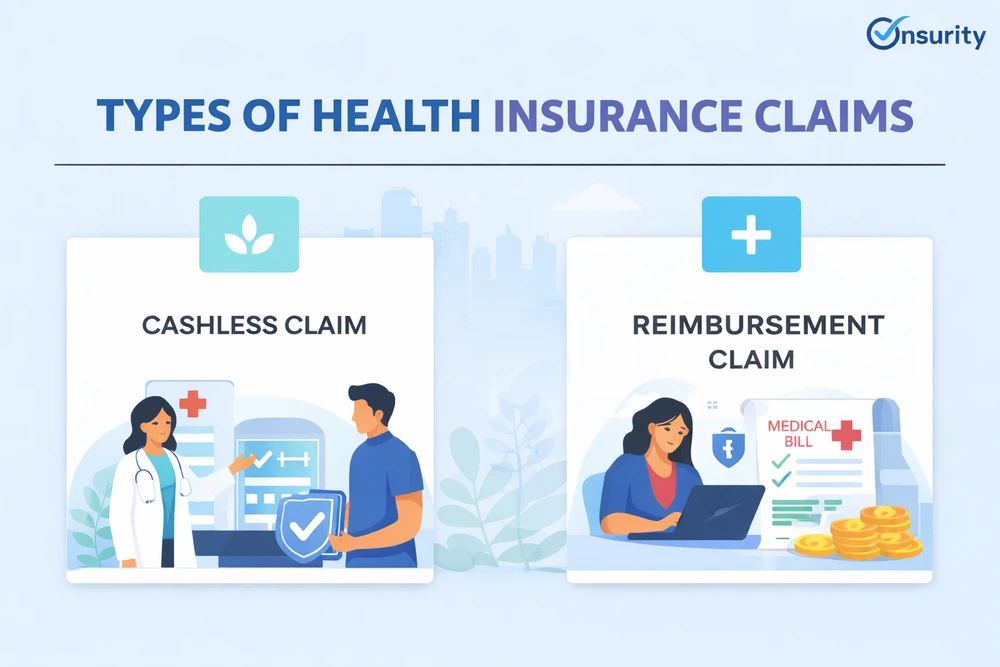
1. Cashless claim for planned hospitalisation
Generally, it’s advisable to contact your insurer 48 to 72 hours before your scheduled admission. For non-network hospitals under the “Cashless Everywhere” network, a minimum of 48 hours notice is mandatory. It’s a pre-approval step, ensuring that when the time comes, you can focus solely on your health, without worrying about the financial bills.
- Submit a pre-authorisation form along with your doctor’s advice and any other relevant documents requested by your insurer to ensure a stress-free experience.
2. Cashless claim for emergency hospitalisation
In case of unplanned hospitalisation, immediate action is required. Get admitted first, and ensure that your insurance company is notified within 24 to 48 hours of admission.
- Once you’re admitted to the hospital, the TPA (Third-Party Administrator) takes over the administrative tasks. They submit the emergency pre-authorisation form to your insurance company, kickstarting the cashless claim process. It’s like having a safety net in place for unexpected healthcare needs.
Quick Read: Cashless Health Insurance Claims
3. Reimbursement claim: Navigating post-treatment costs
For scenarios where cashless facilities aren’t available or opted for, the reimbursement claim process unfolds:
Step 1: Pay and Retain Receipts: Settle the bill directly with the hospital at the time of discharge. It’s crucial to retain every single piece of paper—original bills, receipts, prescriptions, and diagnostic reports serve as your primary proof of medical expenditure.
Step 2: Claim Submission: Fill out the reimbursement claim form provided by your insurer and submit it alongside your collected original documents to the insurance company or TPA within the mandated timeline (usually 7 to 15 days from discharge).
Step 3: Claim Verification: The insurer examines each document to ensure accuracy and adherence to policy terms. Upon successful verification and quality checks, the insurer disburses the eligible reimbursement amount directly into your bank account.
Also, Read: Group Health Insurance for Employees
Step by Step process for filing a Health Insurance claim
1. Cashless Claim Process for Planned Hospitalization
For a scheduled treatment, you have time on your side, so use it.
Step 1: Hospital Selection and Advance Notification: Choose a hospital within your insurer’s network (or select a non-network facility using Cashless Everywhere). You must officially notify your insurance company 48 to 72 hours before your scheduled date of admission. A minimum of 48 hours notice is mandatory if you are using a non-network hospital.
Step 2: Submit the Pre-Authorisation Request: Approach the hospital’s TPA desk. Fill out the pre-authorisation form completely and provide your doctor’s official advice or consultation note, diagnostic test charts, and your digital health card.
Step 3: Await Insurer Approval: The TPA desk transmits your medical paperwork directly to the insurance provider. The insurer reviews the files and issues an initial approval (usually within 1 hour). Once approved, you can proceed with your scheduled treatment worry-free.
Step 4: Final Settlement at Discharge: Upon completion of your treatment, the hospital forwards the final summary and bills to the insurer. Once the insurer clears the final authorization (which IRDAI mandates must be processed within 3 hours), you pay only for non-covered items, like personal consumables, and walk out seamlessly.
Also, Read: Simplifying the Claims Process for Your Employees
2. Cashless Claim Process for Emergency Hospitalisation
In an emergency there’s no time to pre-arrange anything, so the order changes: get the patient admitted first, then start the paperwork.
Step 1: Get admitted and seek treatment immediately. Your health comes first; the claim can follow. This applies whether the hospital is in your network or, under Cashless Everywhere, a qualifying non-network hospital.
Step 2: Inform the insurer within the required window. Most insurers require intimation within 24 hours of an emergency admission. A call to the insurer/TPA helpline or a message through the app is enough to start the process.
Step 3: Submit the pre-authorisation at the hospital desk. The hospital’s insurance desk raises the cashless request with the TPA, who coordinates approval with your insurer.
Step 4: Settle at discharge. Once approved, the insurer pays the hospital directly, just as with planned treatment.
3. Reimbursement Claim Process
Use this when cashless isn’t available (non-network hospital) or you simply choose to pay first and claim later.
Step 1: Pay the bills and keep every original document: You’re the first payer here. Retain all original bills, receipts, and reports, since they are the backbone of your claim.
Step 2: Submit the reimbursement claim form with supporting documents: Complete the form your insurer provides and attach the full set of evidence (see the document checklist below).
Step 3: Insurer reviews and pays: The insurer verifies each document against your policy terms and, once satisfied, disburses the eligible amount to your bank account.
Related Read: Documents Required for Health Insurance
Relevant Documents Required for Health Insurance Claim Process

- 1. Duly Filled Claim Form: This is the foundational document provided by your insurer. It captures essential timelines, breakdown of costs, and details about your medical treatment, ensuring your insurer has the data needed to initiate verification.
- 2. Original Hospital Bills and Receipts: Every single itemized invoice you receive from the hospital billing team along with matching, stamped payment receipts must be saved and submitted. These act as your financial verification trail.
- 3. Medical Certificates and Reports: Official files from your diagnostic labs and healthcare providers detailing your exact illness diagnosis, clinical test summaries, and general treatment plans.
- 4. Prescriptions and Pharmacy Bills: Signed doctor prescription charts detailing your recovery medications along with matching original receipts from the retail pharmacy counters.
- 5. Discharge Summary: Prepared by your primary treating doctor, this document provides a holistic summary of your condition at admission, treatment path, surgical notes, and recovery instructions.
- 6. Photo ID and Health Card: A government-issued photo identity card (like Aadhaar, PAN, or Passport) along with your active digital health card or policy copy to instantly confirm user eligibility.
How To Check the Health Insurance Claim Status?
Monitoring your claim’s progress is crucial. Tracking your claim is your window into the backend of your reimbursement or cashless process. It helps you stay informed, anticipate potential issues, and ensure that your claim moves through the pipeline smoothly, avoiding unnecessary delays. Most insurers allow you to track status via:
- An Online Mobile App or Customer Portal using your Claim Number.
- Direct communication with the hospital’s TPA Helpdesk.
- Calling the Insurers Support Helpline.
Is It Possible to Claim Health Insurance from Multiple Insurers?
Claiming health insurance benefits from multiple insurers is entirely possible. This typically happens when an individual is covered under more than one health insurance policy, such as a corporate group health policy from an employer alongside a personal individual health policy.
The Coordination Process
- Primary and Secondary Insurers: One policy becomes your primary claim source, and the other handles the remaining balance.
- Policyholder’s Right of Choice: Under IRDAI regulations, the policyholder has the absolute right to choose which policy they want to file their claim with first. The strict, old-school contribution clause cannot force you to split a claim up front if your primary policy’s sum insured is sufficient to cover the bill.
- Informing Both Insurers: It is crucial to inform both insurers about the existence of multiple policies to maintain transparency and avoid disputes.
Real-World Example:
Rahul has two health insurance policies: Policy X from his employer and Policy Y, which he purchased individually.
Rahul undergoes a surgery costing ₹50,000.
- Policy X (Primary): Rahul chooses this first; it covers ₹40,000.
- Policy Y (Secondary): Rahul obtains a Claim Settlement Summary from Insurer X and submits it alongside attested document copies to Insurer Y to recover the remaining ₹10,000.
This coordination ensures Rahul receives maximum coverage from both policies without exceeding his total medical expenses.
Related Read: What is Group Health Insurance Policy?
Tips for Policyholders with Multiple Policies:
- Policy Review: Regularly review the terms of all your health insurance policies to understand coordination rules.
- Transparent Communication: Inform both insurers about the existence of multiple policies to facilitate smoother coordination.
- Optimal Utilisation: Understand the strengths of each policy, meaning you can use corporate policies first to preserve your personal policy’s No Claim Bonus.
Also, Read: Why To Invest in Customised Healthcare Plans for Employees?
Common Challenges in Health Insurance Claim Process
Policy Exclusions: Some policies have specific exclusions for certain treatments or pre-existing conditions.
Incorrect Information: Inaccuracies in personal details or medical information.
Waiting Periods: Attempting to claim for a condition during the waiting period when coverage is restricted.
Non-disclosure: Failure to disclose pre-existing conditions during policy application.
Submitting incomplete or inaccurate claim forms can lead to unnecessary delays.
Tips for a Smooth Health Insurance Claims Process to Avoid Rejections
Ensuring a seamless health insurance claims process involves more than just submitting documents; it’s about adopting best practices to mitigate the risk of rejections. Here’s a detailed breakdown of actionable tips:
1. Policy Scrutiny: Understand Your Coverage Inside Out
Policies can have nuances and specific terms. Scrutinising your policy thoroughly ensures you’re aware of its inclusions, exclusions, and any waiting periods.
Read the policy document: Go through your policy document carefully, paying attention to details.
Clarify doubts: If any terms are unclear, seek clarification from your insurer.
2. Timely Intimation: Initiate the Process Promptly
Immediate notification: In case of planned hospitalisation or emergencies, notify your insurer as soon as possible.
Provide essential details: Share all relevant information, such as the reason for hospitalisation and expected treatment.
3. Accurate Documentation: Precision is Key
Create a checklist: List down all required documents for your specific claim.
Double-check details: Ensure all information on forms and documents is accurate and matches the policy details.
4. Proactive Follow-Up: Stay in the Loop
Set follow-up reminders: Establish a schedule for checking your claim status.
Utilise multiple channels: Combine online portals, emails, and direct calls to stay connected with your insurer.
5. Transparent Communication: Keep Your Insurer in the Loop
Inform about changes: If your health status changes during the claim process, update your insurer.
Seek clarification: If you have doubts or concerns, communicate with your insurer promptly.
6. Understanding Policy Limits: Know Your Coverage Cap
Review coverage limits: Know the maximum coverage for different aspects of your policy.
Prioritise expenses: If you have multiple claims, prioritise based on coverage limits.
7. Seek Pre-Approval for Planned Procedures: Plan Ahead
Contact your insurer early: Initiate pre-authorisation for planned treatments well in advance.
Provide complete information: Ensure all necessary details are submitted during pre-authorisation.
By incorporating these detailed tips into your approach, you not only enhance the likelihood of a smooth health insurance claims process but also proactively contribute to a hassle-free experience. Remember, the key is meticulous preparation and staying informed throughout the entire claim journey.
Suggested Read: Difference Between Network and Non-network Hospital
Things To Consider While Applying for Health Insurance Claim Process
Before embarking on the health insurance claim journey, it’s essential to consider various factors to ensure a seamless and efficient process. Here’s a detailed breakdown of what to keep in mind:
Policy network availability: Check the list of network hospitals in your policy documents.
Proximity to your location: Choose network hospitals that are easily accessible to you.
Waiting periods: Know the waiting periods for specific treatments.
Coverage limits: Understand overall coverage limits and any sub-limits for specific treatments.
Pre-existing conditions: Be aware of how pre-existing conditions are handled in your policy.
Sub-limits for treatments: Know if there are specific sub-limits for surgeries, diagnostics, or other treatments.
Policy renewal impact: Understand how claim limits reset during policy renewal.
Initiate pre-authorisation early: Contact your insurer well in advance for planned treatments.
Complete documentation: Ensure all necessary documents are submitted during the pre-authorisation process.
Inform about changes: If your health condition changes during the claim process, update your insurer.
Clarify doubts: Seek clarification from your insurer about any unclear policy terms.
By carefully considering these factors before applying for a health insurance claim, you set the stage for a more informed and successful journey through the claim process. Remember, a proactive and informed approach ensures that your health insurance works for you when you need it the most.
Also, Read: Group Health Insurance Claim Tips
Conclusion
Navigating a health insurance claim does not have to be a second medical emergency. With proper documentation and a clear understanding of the process, you can easily transform a complex hospital maze into a seamless financial safety net.
To support you through this, Onsurity provides a dedicated team of real time doctors called the Good Doctors. They offer end-to-end claims assistance and instant query resolution, ensuring you can bypass administrative stress and focus entirely on your recovery.
FAQs
1. How do I file a health insurance claim?
To file a claim, you must notify your insurance provider immediately after hospitalization. You can choose a cashless claim (at a network hospital) or a reimbursement claim (at any other hospital). For cashless, show your health card at the hospital desk; for reimbursement, pay the bills first and submit the original documents to the insurer later.
2. What documents are mandatory for a reimbursement claim?
To ensure your reimbursement isn’t rejected, you must submit:
Original hospital bills and payment receipts.
A detailed discharge summary.
Doctor’s prescriptions and pharmacy invoices.
Diagnostic reports (X-rays, blood tests, etc.).
A duly signed and filled claim form.
3. Can I claim medical expenses from two different health insurance policies?
Yes, you can use two policies through coordination of benefits. The first policy (Primary) pays up to its limit, and the second (Secondary) covers the remaining balance. Always inform both insurers about the multiple policies to ensure a transparent and legal settlement.
4. What happens if I file a claim under an expired health insurance policy?
An expired policy is no longer valid. If your treatment starts even one day after the policy expires, the insurer is not legally bound to pay. Always renew your policy before the due date or during the “grace period” to maintain continuous coverage.
5. How long does the health insurance claim process take?
While cashless approvals usually happen within 2–6 hours, reimbursement claims typically take 15 to 30 days after all documents are submitted. Using a digital-first provider like Onsurity can significantly speed up your documentation and tracking.
6. What is the "Claim Settlement Ratio" and why does it matter?
The Claim Settlement Ratio (CSR) is the percentage of claims an insurer pays out of the total requests received. For example, a 98% CSR means the company is highly reliable. Always check the CSR before buying a policy to ensure the insurer has a history of honoring claims.
7. What are the key stages of the health insurance claim cycle?
The claim cycle consists of five main stages:
- Intimation: Notifying the insurer.
- Pre-authorization: Getting approval for treatment (for cashless).
- Documentation: Submitting all medical evidence.
- Adjudication: The insurer verifying the medical necessity.
- Settlement: Final payment to the hospital or policyholder.